
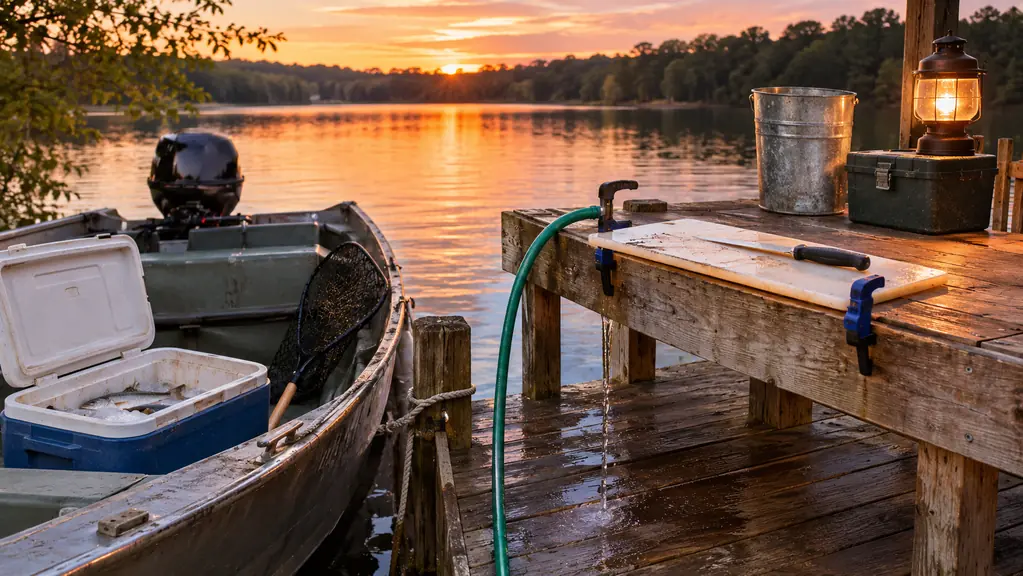
There is a point at the cleaning table where a knife stops being a tool and starts being an argument. For me it comes about halfway through a limit of bass, when the fillet is already loose from the spine and the only thing left between the meat and the skin is half an inch of patience. The BUBBA 7 Inch Tapered Flex Fillet Knife handles that half inch better than anything else I have carried in the boat. An electric fillet knife gets through the other thirteen fish faster. Both of those things are true, and which one matters depends on how you fish and how many you keep.
Here is the short answer. If you clean six fish at the end of a trip and you want them to look like something, buy the BUBBA. If you come off the water with a live well that looks like a bait shop inventory, a Rapala electric fillet knife will save you an hour and a half and a sore wrist. The rest of this is why, and where each one quits on you.
| BUBBA 7 Inch Tapered Flex | Rapala electric | |
|---|---|---|
| Blade and control | 7-inch tapered flex blade in 8Cr13MoV steel, straight edge, V-grind, thin enough to feel the ribs through it | Two reciprocating blades driven by a motor, so the cutting stroke is done for you |
| Speed on a big pile of fish | Steady and accurate, one fillet at a time | Fast blades clear a cooler of panfish in roughly half the time |
| Working around the rib cage | Tapered tip slides under the ribs and along the spine with very little waste | Easy to run past the rib and into the fillet if you lean on it |
| First-timer learning curve | Takes a few fish to learn the angle and the pressure | The motor supplies the stroke, so a beginner turns out a passable fillet sooner |
| Heavy bones on big fish | You will work at a sheepshead rib section and feel it in your hand by the end of the pile | Pushes through a heavy rib section without much effort at all |
| Working with no power | Nothing to plug in and nothing to charge | Needs an outlet, a battery pack or a boat circuit |
| Hands and safety | Non-slip trigger grip with safety guards between your hand and the blade | Blades are exposed and moving whenever the trigger is down |
| Cleanup at the table | Hand wash, dry it, back in the sheath | Blades come apart to clean and the motor housing has to stay dry |
| Room in the boat | 9.6 ounces with a sheath, drops into a side pocket | Bulky handle and a cord take up a whole compartment |
| Skinning a fillet | Works if you keep the blade flat and let the flex follow the skin | Also works, and faster on a thick-skinned fish |
Where the BUBBA Wins
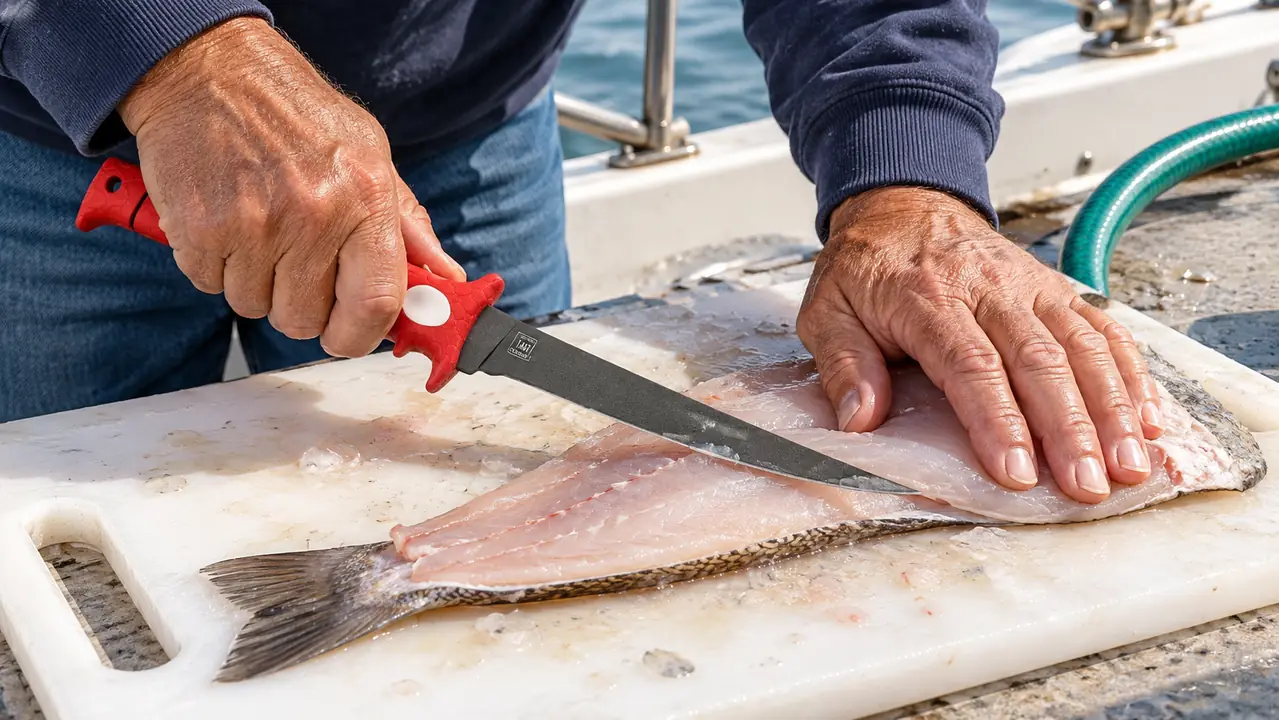
Control is the whole case, and control is not a feeling you can put on a hang tag. The 7-inch tapered flex blade is thin steel, and thin steel carries information. When the edge crosses the line where the rib meets the meat, you feel it in your fingers before you see it. Run a blade that does not do that for one season and you will understand how much fillet you were leaving on the frame without ever knowing it.
The handle is where the BUBBA surprises people who only look at the blade. It is ambidextrous, which matters in my house because my son Travis is left-handed and borrows everything that is not nailed down. The non-slip grip has a trigger shape that puts your index finger forward of the rest of your hand, so the knife sits in your palm instead of sliding around in it. There are safety guards on the handle as well, and a bass will spine you exactly once before you start caring about that.
Then there is everything that is not cutting. Nothing to plug in, nothing to charge, nothing to keep dry except the blade. The knife is 13 inches overall with a 7-inch blade and weighs 9.6 ounces, it comes with a sheath, and it drops into a side pocket of the boat bag where I can find it with one hand in the dark. Care is hand wash only, dry it, back in the sheath. It carries a one-year limited warranty from BUBBA, which so far I have not had to use.
One more thing that does not show up on a spec sheet. In January the water is in the forties and my hands are stiff before I ever pick up a knife. On a cold morning a hand knife is a slow, deliberate tool, and that is exactly what I want with a catfish flopping on a wet board. There is no cord to catch on a cleat and no blade stroking away under my fingers while the boat rocks. I have cleaned a dozen channel cat on a thirty-eight degree morning with the BUBBA and never once felt like I was one wrong shift of weight away from a bad cut.
The blade is thin enough that I feel the rib come up through the steel before the edge ever gets there. That is the whole argument for a hand knife, and no motor can hand it to you.
Where the Rapala Wins
I am not going to pretend an electric is a toy, and I am not going to pretend the speed difference is small. Two reciprocating blades stroking fast will walk through a crappie before your hand has finished deciding to move. On a thirty fish evening, which happens two or three times a spring on the bayou, that gap is real and it gets measured in how late you sit down to supper.
It is also more forgiving for somebody who has never cleaned a fish. The motor supplies the stroke and you only supply the direction, which removes most of what makes a first fillet come out ragged. That is why so many people who clean fish for a fish fry, or who clean them for a living, keep one on the shelf next to the hand knives.
And on a sheepshead or a drum with a heavy rib section, the electric just pushes through. You do not have to lean on it, you do not have to saw at it, and your hand is not aching at the end of the pile. There is a reason the cleaning houses down at the coast run electric and not hand knives. They are not sentimental about it, and neither am I.
The last thing is not about the cut at all. It is about a man with a bad wrist. My neighbor across the road had surgery on his right hand two winters back, and he could not get through a pile of white perch with a hand knife to save his life. He borrowed an electric and finished twenty-two fish without stopping. When a joint wears out, a motor is not a luxury, and I would tell anybody with arthritis the same thing I told him.
The knife I reach for when the fillet has to come out clean
7-inch tapered flex blade in 8Cr13MoV steel, non-slip trigger grip, safety guards, sheath included. Hand wash it, dry it, and it goes back in the boat bag.
Amazon Check Today's Price on Amazon →What the Tapered Flex Blade Is Actually For
Tapered flex means the spine thins toward the tip, so the last couple of inches give when you push them. That is not a shape somebody picked out for looks. It is how you slide a blade under the ribs and along the backbone without gouging through and without chopping the fillet in half. A 7-inch blade on a 13-inch knife is long for panfish and about right for bass, redfish and catfish, which is most of what comes over the side of my boat.
The steel is 8Cr13MoV stainless with a V-grind, a straight edge and a trailing point. In plain terms it takes an edge fast, holds it through a mess of fish, and does not spot up on you if you dry it off. Hand wash only is not the manufacturer being fussy. Dishwasher heat and detergent will ruin the edge and dry out the handle, and then you are shopping for another knife.
What it will not do is cut your cleaning time in half. If your problem is forty fish and a bedtime, this knife is not the answer to that problem and I would be lying to tell you otherwise. If your problem is that half your fillets come off ragged and you are tired of leaving meat on the frame, this is exactly the answer to that problem.
The Saturday We Cleaned Thirty Crappie Two Ways
My granddaughter Kaylee is 11 and she fishes in a life jacket whether she likes it or not. Back in the spring we got into the crappie on a bayou off the lake and put thirty in the live well before noon. She wanted to help clean them, and I was not about to hand an 11-year-old an electric knife with two moving blades and a cord running across a wet deck.
So we split the pile. I ran the BUBBA on my half and she held the fish flat and watched. By the fourth fish she had my hand over hers on the handle, working the skin side. The tapered tip let her feel where the rib ended, and she quit pressing down so hard somewhere around the sixth one, which is the entire lesson in one sentence.
Then it got hot, and we had a fish fry to get to, so I plugged in the electric and finished the rest at about twice the speed. That is the honest picture. The hand knife taught the skill. The electric got us to supper. I would not want to be without either one, but only one of them lives in the boat bag.
What I remember most is not the speed. It was watching her figure out that the knife talks back. Somewhere in that second dozen she stopped pushing and started listening, and the fillets came off the frame in one piece instead of two. That is a thing you cannot teach with a motor, because the motor does the listening for you. She is eleven and she is already better at the skin side than her daddy was at twenty.
Keeping an Edge on It
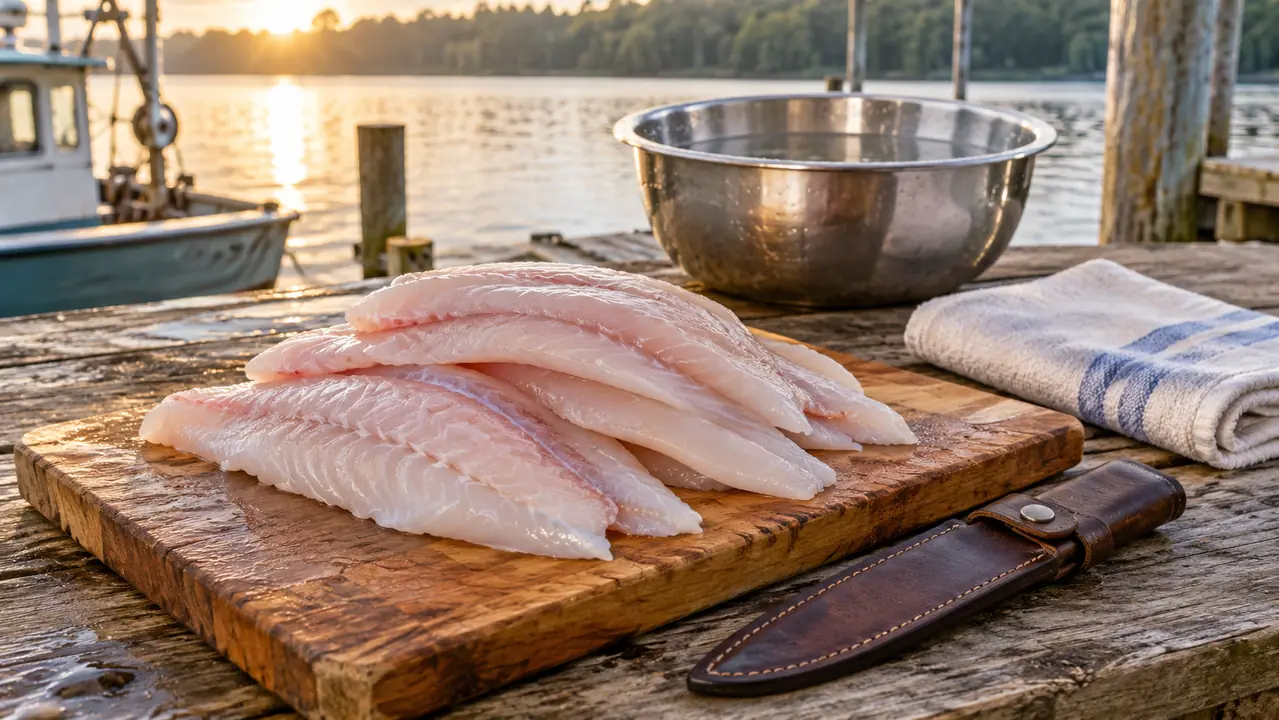
A thin blade cuts because it is thin, and thin blades do not tolerate being dragged across the edge of a cutting board or tossed in a toolbox. I keep a small stone in the boat bag and give the BUBBA six or eight passes on each side before a trip. That is more upkeep than an electric, but it takes less time than finding an outlet at a cleaning table at nine at night.
Storage matters too. The sheath is not there so the knife looks finished. It is there so the edge is not knocking against a pair of pliers and a spool of line in the bottom of a bag. Wash it, dry it, sheath it, and a 7-inch blade stays a 7-inch blade for a long time.
I learned that the hard way with the last hand knife I owned. It rode loose in the bottom of the boat bag for a season, edge against the jaw of a pair of needle-nose pliers, and by August it would not cut warm butter. I tried to bring it back on the stone and got most of it, but the tip had rolled and never came back square. Nineteen dollars of stone work and I still retired it. The sheath costs nothing extra and saves you the whole afternoon.
What Decided It For Me
The first thing was the trip after the trip. A knife that lives in the boat bag has to survive being forgotten. The BUBBA got left in a wet side pocket overnight twice last summer, and both times I rinsed it, dried it, touched the edge up on a stone and put it back to work. An electric left out in the rain is a phone call to the manufacturer.
The second was the fish I actually catch. Most weeks I come home with four to eight fish, not thirty. For that, an electric is a cord, a cleanup and a compartment of space solving a problem I do not have. What I do have is a cooler of fillets I want to look like something when I put them on ice for Darlene's brother.
Who Should Buy Which
Buy the BUBBA if you clean a handful of fish per trip and you care what the fillet looks like when you are done. Buy it if you fish out of a small boat or off a bank where there is no power, if you want one knife in a sheath that weighs 9.6 ounces and never needs an outlet, or if you are teaching somebody to clean fish and you want them to learn feel before they learn speed.
Buy the electric if the freezer is the point. If you keep everything you catch and you clean thirty or more in a sitting, the time saved is worth the cord and the cleanup, and it is not close. Buy it also if your grip is not what it used to be. A motor doing the stroke your wrist used to do is a real reason, not a small one.
Plenty of people keep both, and I am one of them. The electric sits on the shelf for the two or three trips a year that turn into a fish fry. The BUBBA is in the boat bag every trip, because the trip where you only catch four fish is still a trip where you have to clean four fish, and that is the trip you will not have planned for.
One knife in the boat bag, ready when the bite turns on
13 inches overall, 7-inch tapered flex blade, non-slip grip, safety guards, sheath included, 9.6 ounces. Rinse it, dry it, and it is ready for the next trip.
Amazon Check Today's Price on Amazon →