
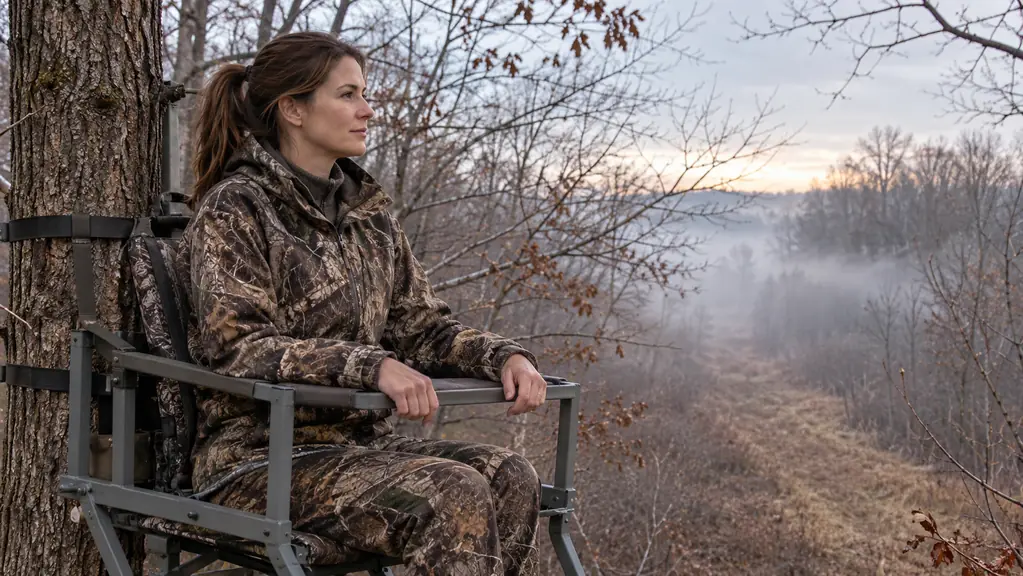
The first ladder stand I ever climbed, I climbed without a harness, because I was 31 and nothing bad had happened to me yet. That is how most of us learn. I am 63 now, a retired pipeline welder outside a small town in north Louisiana, and I have hunted whitetail off the same family lease for a long time. Somewhere in there the arithmetic changed. A fall of fifteen feet does not care how careful a man is. So the Muddy safety harness hangs on a hook in my shop, and it goes on before my boot hits the first rung.
What follows is not an argument. It is the list of ten things that put that harness in my truck and kept it there, in the order I actually noticed them. Some of it is comfort. Some of it is the paperwork printed on the listing. One or two items are the kind of thing you only come to appreciate at 5:40 in the morning with cold hands and a headlamp in your teeth.
Two pounds of nylon against a fifteen-foot fall
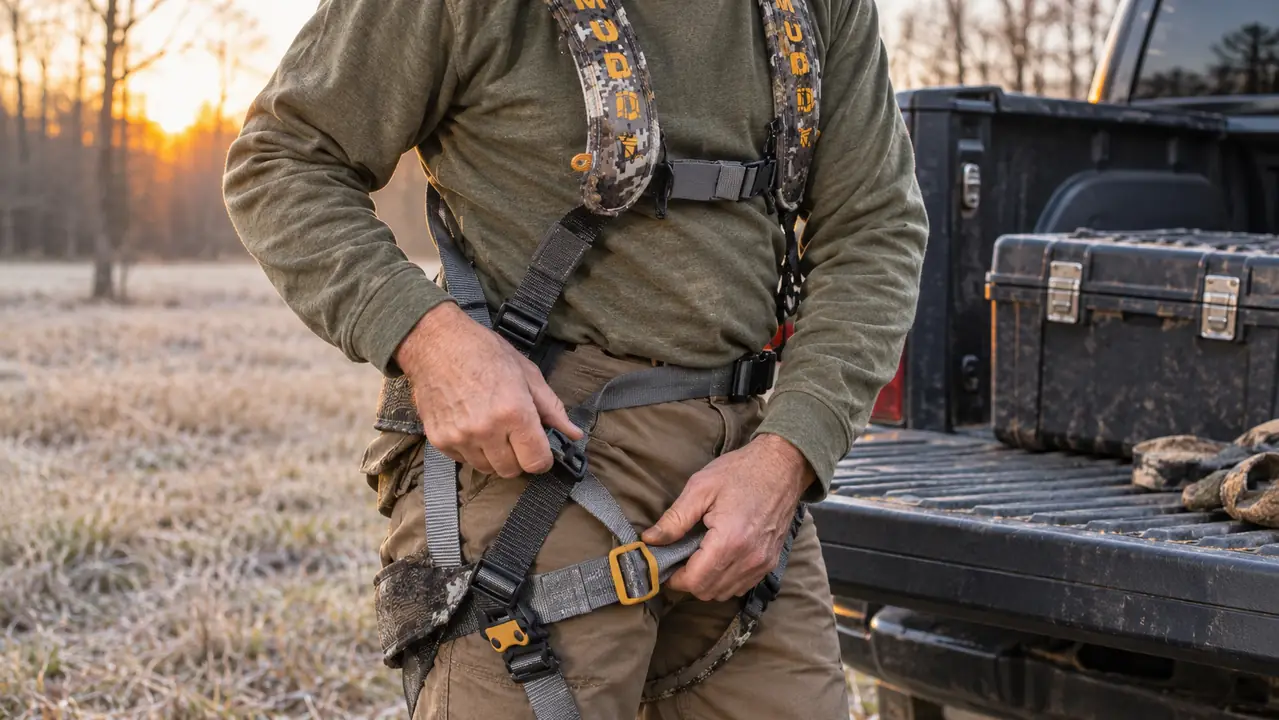
The Muddy harness is one size, rated to 300 pounds, padded at the shoulders and legs, and hand wash only. It is the least interesting thing in my gear pile and the only thing I never leave the truck without.
Amazon Check Today's Price on Amazon →Two pounds you quit noticing by the second rung
The listing puts the harness at 2 pounds, and that number does more work than it sounds like it does. A harness you can feel on your shoulders is a harness you take off halfway up the ladder. This one goes on over a shirt, settles down, and by the time I have my pack hung on the hook I am not thinking about it anymore. That matters more than any feature on this page. The best safety gear is the gear you actually wear on every sit, including the short ones where nothing is supposed to happen.
A 300-pound rating is not a round marketing number
Weight capacity on the listing is 300 pounds. I run a shade under 200, and late season I hunt in long johns, insulated bibs, a heavy coat, with a stand cushion, a pack and a thermos of coffee on me. That is a lot of extra load hanging off the same straps. Knowing the Muddy harness is rated well past anything I will ever put in it means I am not doing arithmetic in my head at first light. Check your own numbers against that rating and be honest with yourself about how you dress in December.
Padding in the two places that actually rub
Padded nylon at the shoulders and through the leg straps is the difference between an all-day sit and a two-hour sit. The shoulder straps are what carry the harness on the walk in. The leg straps are what remind you that you have been sitting still for three hours. Both are padded here. I have worn bare webbing in the past and spent more time shifting around than watching the lane. Comfort is not a luxury item on a tree stand. It is what keeps you seated instead of standing up to stretch at the worst possible moment.
Low-stretch webbing that stays where you set it
The fabric is described as low stretch, and that is the right call for a harness. Stretchy webbing creeps. You set the leg straps where you want them at the tailgate, walk two hundred yards, and now they are somewhere else entirely. Low-stretch nylon holds its adjustment, so once I have the fit dialed in at the truck it is still the same fit at the top of the ladder. Small thing on paper. It is also the whole difference between a harness that fits and a harness you are forever fiddling with.
Quick-release, so getting out is not a wrestling match
The quick-release hardware named in the title is the part I use most, and it is the part you use in the dark with gloves on. When the sit is over and my hands are cold and stiff, I do not want to be picking at a buckle for two minutes at fifteen feet. Quick release gets me out of the harness and back onto the ladder with my attention where it belongs. I still take my time on the climb down. I just do not want the harness adding to the problem while I do it.
The best safety gear is the gear you actually wear on every sit, including the short ones where nothing is supposed to happen.
One size, cut to go over whatever the morning hands you
The harness is one size with a standard fit, and it goes on over a t-shirt in October or over bibs and a parka in December. I have adjusted it for both and not run out of strap either way. If you are small framed, check the adjustment range before you order, because one size never means one size fits every body perfectly. For most grown men in hunting layers the range is generous. Set it once at the truck with your heaviest coat on, then leave it alone for the season.
It lives in the toolbox, not in a tote in the garage
Folded, this harness takes up about the room of a pair of bibs. Mine rides in the truck toolbox next to a spare headlamp and a set of gloves. That is deliberate. Gear that lives in the truck gets used. Gear that lives in a tote in the garage gets remembered about a quarter mile from the stand, which is the same as not having it. Two pounds costs you nothing in space and nothing in fuel mileage. It costs you something only on the days you leave it home.
The whole maintenance routine is a bucket and a hook
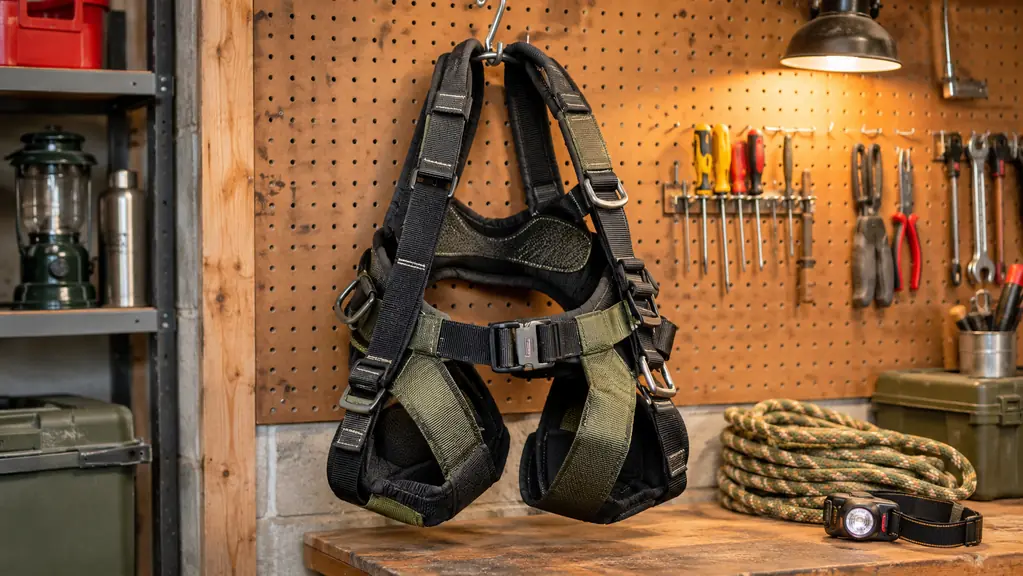
The care instructions say hand wash only, and I will not pretend that is a hardship. End of season I fill a bucket with cool water and a little mild soap, work the straps through it, rinse, and hang it in the shop out of the sun. I do not put it in the machine and I do not put it in the dryer. While it is hanging there I run my hands over every strap and every stitch, because a harness is not a piece of gear you retire quietly. You inspect it, or you do not wear it. That is the whole rule.
A one-year limited warranty spelled out on the listing
The warranty description reads one year limited, and it is stated right on the listing instead of buried in fine print you have to go dig for. I like that. A warranty is not why a man buys a harness, but a company willing to put the terms in the open is telling you something about how the thing is built. Read it yourself before you order, then keep the receipt somewhere you can find it. A warranty you cannot prove you own is not worth the paper it is printed on.
It ends the conversation at the truck door
Darlene asked me for years whether I was wearing it. Now she does not ask, because she watches me put it on before I load the rifle. That is worth more than two pounds. My son Travis hunts with me some, and I gave him the same speech my father never gave me. A harness turns a fifteen-foot fall from something that ends a season into something that ruins an afternoon and no more. That is the trade, and I will make it every single time I climb.
What I'd Skip
I would skip a used harness off a table at a flea market. You do not know its history, you do not know whether it has taken a fall, and nylon will not tell you when it has been overloaded. I would also skip the notion that the harness by itself makes a stand safe. It does not. The stand has to be sound, the straps have to be tight, and you have to be connected from the moment your boots leave the ground. A harness is one link in a chain, and the rest of that chain is your job.
I would skip buying this and then not reading what is in the box. The listing names the harness as the included component, so get on flat ground well before opening day and sort out your tether, your tree strap and your lifeline situation. Then hang in it at knee height and let your weight settle into it before you ever trust it at fifteen feet. I would also skip leaving it in the truck bed under a summer sun all off-season. Mine hangs on a hook in the shop, and it has stayed sound.
The cheapest thing you will ever hang between you and the ground
One size, 300-pound rating, padded nylon, hand wash only, one-year limited warranty. Put it on at the tailgate, not at the first rung.
Amazon Check Today's Price on Amazon →