
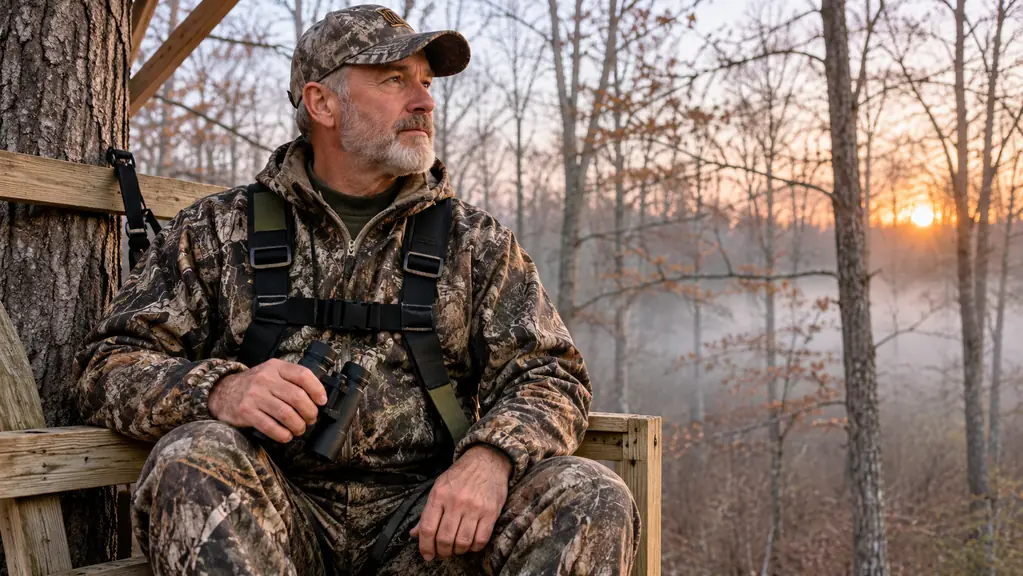
I have climbed into ladder stands on a north Louisiana lease for close to 45 years, and for most of that time I treated a harness like a formality I put on when somebody was watching. That changed the morning a rung let go under my boot about eight feet up. I did not fall. I also did not sleep that night. Since then I have been particular about what holds me in a tree, and I spent two full deer seasons running two setups side by side: the MUDDY quick-release harness and a Hunter Safety System vest.
Here is the short answer, then I will show my work. The MUDDY is a padded nylon harness that weighs 2 pounds, comes in one size, and is rated to 300 pounds. It rolls up small, goes on over a coat without a wrestling match, and by the time the sky turns gray I have forgotten I am wearing it. The Hunter Safety System vest is a different animal. The straps are sewn into a garment with pockets and a zipper, so it carries your rangefinder and your phone and keeps the webbing where you left it. One is a tool you strap on. The other is clothing that happens to be a tool.
| MUDDY Quick-Release Harness | Hunter Safety System Vest | |
|---|---|---|
| Design | Padded nylon straps and quick-release buckles worn over your clothes | Straps sewn into a full vest that zips on like a jacket |
| Weight | 2 pounds on the scale | More fabric and more pockets to carry on your shoulders |
| Bulk under layers | Low-stretch webbing lies flat under bibs and a parka | A whole garment layered on top of everything else you already wear |
| Packing it in | Rolls into a ball and fits in a daypack or a truck box | Not made to pack, you wear it in or carry it flat |
| Fit across layers | One size, adjusts from a T-shirt to a heavy coat | Cut in sizes for a closer fit, but you can land between two |
| Pockets | No pockets at all, your coat or your pack carries the gear | Chest and waist pockets for a rangefinder, phone and release |
| Straps in the dark | Loose webbing can tangle in the truck box if you coil it wrong | Straps stay sewn in place, less to sort at the base of the tree |
| Long sits | Padded shoulders and legs, still a strap harness by hour four | The vest spreads the load across shoulders and back |
| Care and warranty | 1 year limited, hand wash only | Limited warranty on the vest, read the current terms |
| Weight rating | Rated to 300 pounds | Rated as well, but check the tag for your size |
How I Compared Them
Same lease, same ladder stands, two seasons. I wore the MUDDY on the stand I hunt most, a 16-foot ladder in a creek bottom, and kept the vest for the stands I have to walk into and sit longer. I alternated on purpose instead of wearing whichever one I grabbed off the hook, and I wrote down what bothered me in a spiral notebook I keep on the dash. This is not a laboratory test. It is a lot of dark mornings and a fair amount of cold.
The things I measured were simple. How it felt on the walk in. How it felt at hour three. How it went on in the dark with gloves. And whether I was still wearing it in January. That last one is the only test that really counts, because a harness left in the truck box does nothing for you no matter what the tag says.
Where the MUDDY Wins
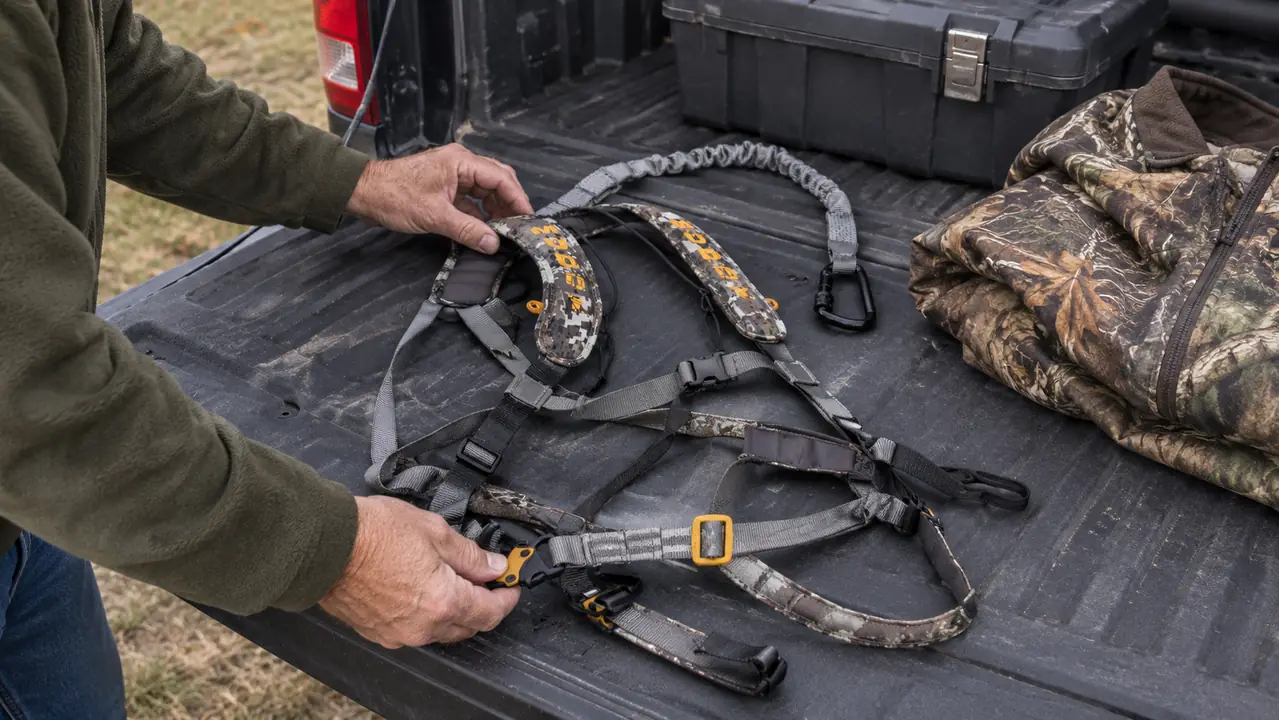
Start with the scale, because that is most of the argument. Two pounds. I have hung it on a hook in the shop beside a bag of pecans to check, and that is close enough. A harness you do not mind carrying is a harness you will carry, and that matters more than any line on a spec sheet. Mine lives in the truck box year round in a mesh bag with my headlamp, and it goes with me whether I am hunting or just walking a fence line in November.
The one-size fit does more work than it sounds like it should. In October I am climbing in a shirt and a light vest. By late season I am in insulated bibs and a parka that makes me look like a bear standing up. The MUDDY adjusts out over all of it and comes back in for the early season without me having to think about it. I still check the webbing every single climb and pull it snug, because loose straps are worse than no straps at all.
The nylon is low stretch, and I did not appreciate that until I sat back against it in cold weather. Some harness webbing gives a little when you load it, and giving a little at 18 feet feels like giving a lot. This one does not stretch under you. The padding on the shoulders and leg straps means I can sit from dark thirty until nine o'clock without the blood going out of my legs, which is the difference between hunting and enduring.
It also packs. Rolled tight it takes up about as much room as a loaf of bread, so it goes in the bottom of a daypack on public land where I am walking a mile before daylight. The vest does not do that. That single difference decides which one I take on the walk-in hunts, and I take more of those than I used to.
Where the Hunter Safety System Vest Wins
Now the other side, because a vest does things a strap harness cannot. Pockets, and real ones. Chest and waist, sized for a rangefinder, a call, a phone, a release. When I wear the vest I leave my fanny pack in the truck. At 30 feet, not having a bag swinging off my hip while I try to turn my body is worth something you cannot put on a spec sheet.
The straps stay where they belong. On a plain harness, if you coil it wrong in the truck box, you get to the base of the tree in the dark and spend five minutes untangling webbing like a man sorting Christmas lights. The vest is one sewn piece, so you zip it on and you are finished. If you hunt with somebody who does not wear a harness every day, the vest is easier to teach, because there is only one way it goes on and no loose ends to second-guess.
And the vest carries the weight across your shoulders and back instead of hanging it off two straps. On a two-hour sit in January, that is the difference between the last hour being pleasant and the last hour being a countdown. My son Travis borrowed my vest two seasons back and has not returned it, which tells you what he thinks of it.
Two pounds in a mesh bag in the truck box gets worn on every single hunt. A vest I have to remember to bring gets worn when I remember.
Two pounds you will still be wearing in year three
The MUDDY quick-release harness comes in one size, rates to 300 pounds, and adjusts from a September T-shirt to a December parka. It rolls up, it goes on in the dark, and it does not need a bag of its own.
Amazon Check Today's Price on Amazon →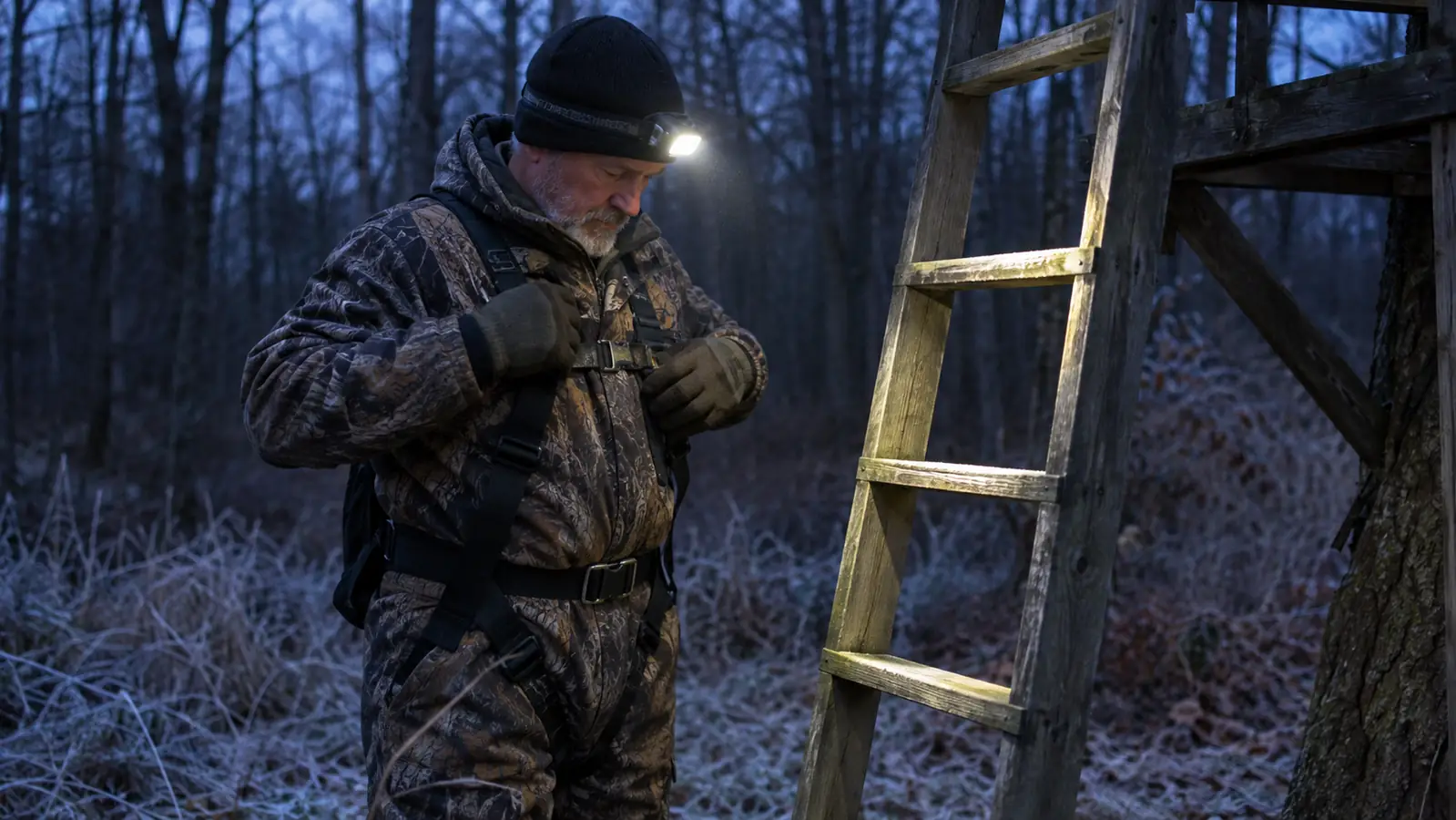
Two Seasons in the MUDDY, Honest Notes
I bought mine the summer before the season and hunted it hard, roughly 40 sits the first year and fewer the second because the deer did not cooperate. The quick-release buckles are the part I use most. I climb with the leg straps loose and cinch them once I am seated, and those buckles open clean with gloves on, which is not true of every buckle I have owned.
Buckle placement under the arm took me a couple of climbs to get right. The first time up I had one sitting where the strap crossed my ribs, and it bit me every time I turned my shoulders. Loosen, shift, retighten, and it went away. That is not a defect. It is a harness that has to be fitted to a body, and any honest account should say so.
The stitching has held. The padding has not flattened out. The webbing shows no fuzz at the edges after two seasons, and I check it in good light before every season the way you should check any piece of life-safety gear. If I ever found a cut or a worn stitch I would retire it that day, and I would tell you the same about any brand on the shelf.
What I do not love. No pockets, so my coat does the work. The straps will tangle if you stuff it in a bag carelessly. Hand wash only means it does not go in the machine with the hunting clothes, so mine gets rinsed in the bathtub in February and hung on the porch rail to dry. And one size is not truly one size for everyone. It fits me fine at 5 foot 10 and 210 pounds, but a small-framed hunter will have strap ends to manage.
The Mistakes I Made With Both
I wore the vest too big the first year. I bought it to fit over a parka and then wore it in October over a shirt, and it rode up my back all morning. Fit the thing to the layers you actually hunt in most, not to the worst case you imagine in August.
I also climbed with the MUDDY leg straps loose more than once, telling myself I would cinch them once I got settled. Do it at the bottom, before your boots leave the ground. Every season somebody in this parish finds out why that matters, and I would rather it not be me or mine.
The dumbest one: I left the harness in the truck box through a wet January and the webbing came out smelling like a bait shop. Hand wash, air dry, and it does not happen again. That one is on me, not on MUDDY.
One more. I never looked at a weight rating on my first harness until I had owned it four years. The MUDDY is rated to 300 pounds, and that number includes you, your boots, your bibs and anything you haul up the ladder with you. If you are a big man in heavy winter clothes, do the arithmetic honestly instead of assuming.
Who Should Buy Which
Buy the MUDDY if you want light and simple. If you hunt public land and walk in a mile, if everything you own goes into one pack, if you already carry a small bag and do not want anything else on your chest, this is the one. It also suits a hunter who climbs in the same rig over a T-shirt in September and a parka in December, because one size covers both without a second purchase.
Buy the vest if you sit long and hate a pack. If your rangefinder, phone and release need a home and you would rather not haul a bag up the ladder, those pockets and the sewn-in straps are worth the extra fabric on your back. It is also the better pick for anyone new to tree stands, or for a hunting buddy you are trying to keep alive, because there is no puzzle to solve at the bottom of the ladder in the dark.
Neither one replaces the rest of it. A harness only works with a tether and a tree strap rated for the job, and it only works if the stand is sound and you are clipped in from the moment your feet leave the ground. I have climbed without a harness. I was younger and I was lucky, and luck is not a plan I would hand to my granddaughter.
One harness, every layer, every climb
The MUDDY quick-release harness weighs 2 pounds, fits over a shirt or a parka, and rates to 300 pounds. Rinse it by hand once a season, check the webbing, and hang it by the door so it goes with you.
Amazon Check Today's Price on Amazon →