

A catfish will dull a knife faster than anything else that comes over the side of the boat. Not because the steel is soft, but because a man gets in a hurry, drags the edge across the spine, and then wonders why the next fillet comes off in chunks instead of slabs. I cleaned fish with stiff kitchen blades for the better part of twenty years before it occurred to me that the blade was the problem and not my hands. Catfish are not bass. The skin is tough, the ribs are stubborn, and there is no clean seam running the length of the fish to follow. You have to feel your way through it, and a stiff blade will not let you feel anything.
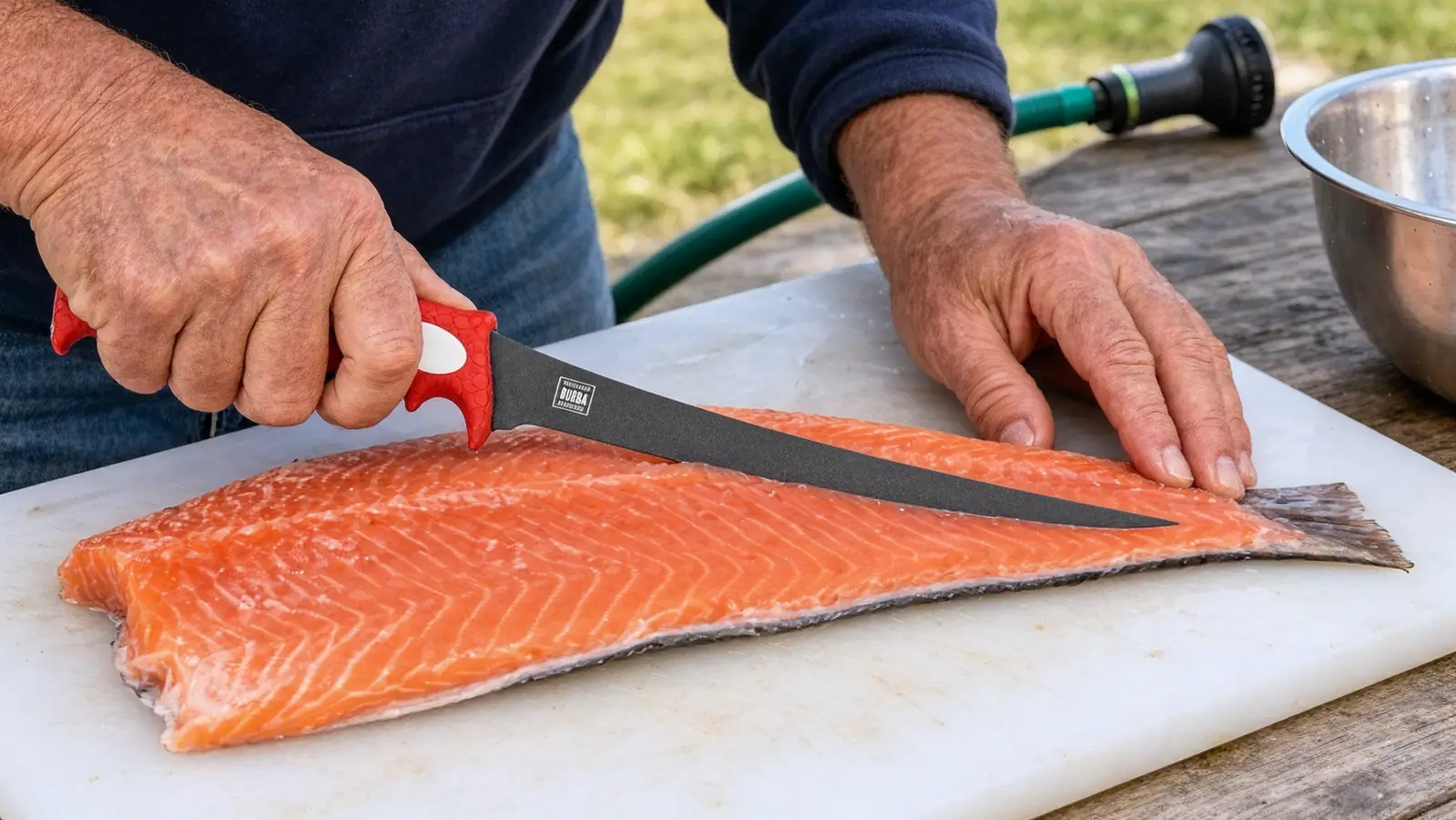
The knife that lives in my truck toolbox now is the BUBBA 7 Inch Tapered Flex Fillet Fishing Knife. Thirteen inches overall, seven inches of blade, and a super thin 8Cr13MoV blade that bends when you ask it to and still holds an edge through a limit of crappie. The handle is a non-slip grip with a trigger grip that keeps your hand where it belongs when your fingers are slick with slime, and there are safety guards between your knuckles and the spines. It ships with a sheath, which matters more than most people give it credit for. I have cleaned a lot of catfish and a lot of crappie with this knife, and what follows is the way I do it now.
One tapered blade instead of three knives rolling around the toolbox
Seven inches of tapered flex on a thirteen inch knife, a non-slip grip with a trigger grip, and safety guards between your fingers and the spines. This is the blade I reach for whether the cooler is full of catfish or crappie.
Amazon Check Today's Price on Amazon →Before the First Cut: Set the Station Up Right
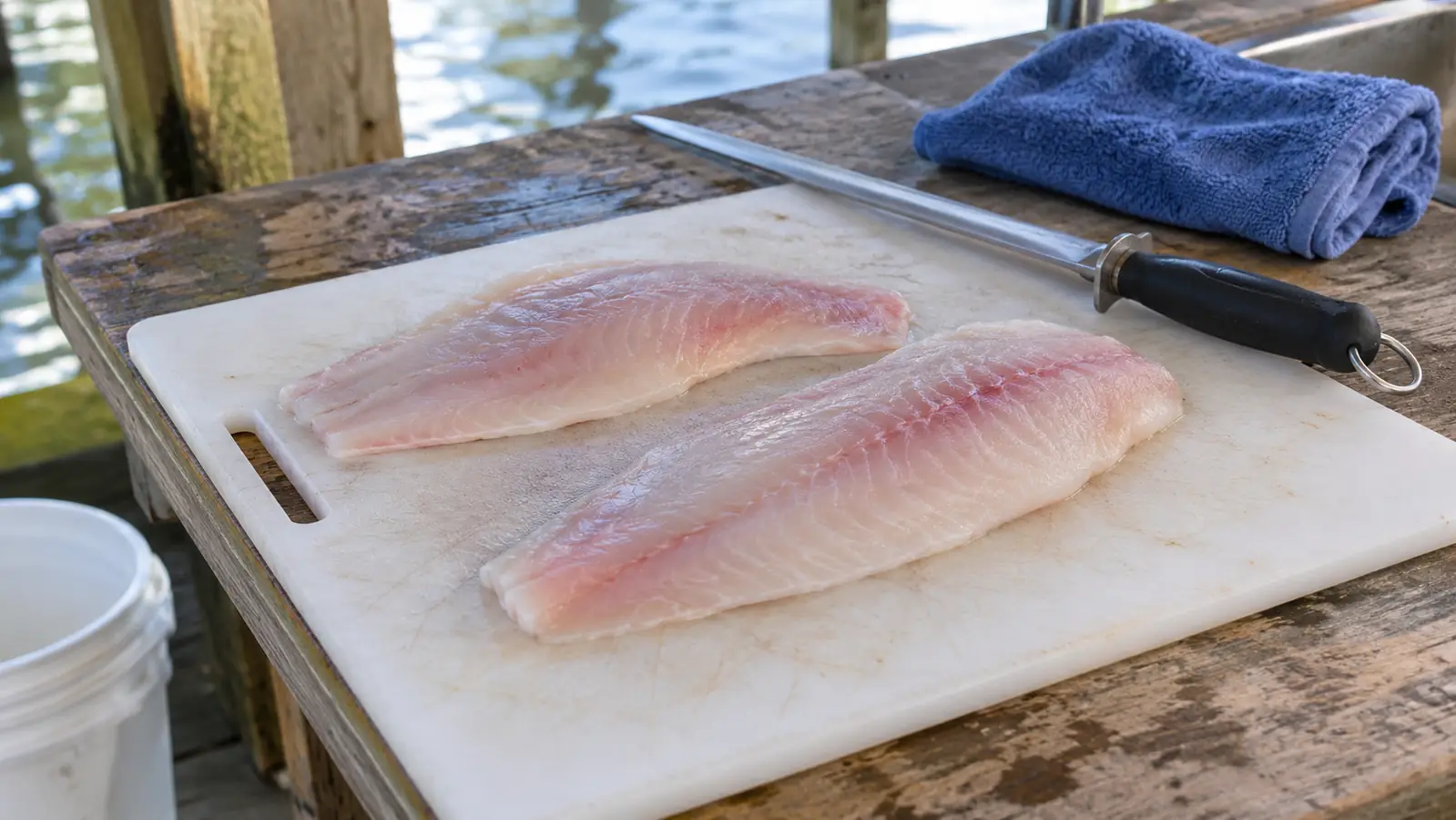
Most bad fillets are decided before the knife ever touches a fish. If the table is cluttered and the fish are sliding around, you will rush, and rushing is what turns a fillet into fish nuggets. I use a plastic folding table with a lip around the edge, a white cutting board so I can see the meat against it, a hose with a spray nozzle clipped to the leg, and a five gallon bucket underneath for the carcasses. A folded towel on the corner is where the knife sits when it is not in my hand. Never on the board, and never on the rail of the boat.
Leave the fish on ice until you are ready to work on that one fish. A catfish that has been sitting in the sun while you clean your way through a cooler goes soft, and soft fish will not hold a fillet no matter what knife you pick up. I pull them one at a time and I put the lid back down every time. It sounds like fussing. It is not. It is the difference between a clean slab and a mess.
Step 1: Check and Touch Up the Edge Before the First Fish
I run the blade over a fine diamond steel, four or five light strokes per side, at the angle the edge already has. The BUBBA comes with a V-grind straight edge on a thin 8Cr13MoV blade, and thin steel sharpens fast and dulls fast. That is the trade you make when you want a blade that will flex. A few passes before each batch of fish keeps it cutting without grinding metal off a blade that does not have much to spare.
Check the edge on your thumbnail, not on your palm. If the edge catches the nail and does not slide off, you are ready. If it slides, give it four more strokes and check again. What you are after is not a razor. You want a slightly toothy edge that will bite into catfish skin instead of skating across it, because skin is where most people lose the whole fillet before they have made a single cut.
One thing I learned the hard way: do not use a pull-through carbide sharpener on a thin fillet blade. It takes off more steel than the blade can afford, and a flex knife ground too thin will fold over the first time it meets a rib. A steel is enough. If the knife is genuinely dull and the steel will not bring it back, deal with that at the bench at home, not on the water with a cooler waiting.
Step 2: Make the Head Cut and Open the Fish Behind the Gills
Lay the catfish on its side with the head toward your off hand. Cut down at a slight angle just behind the gill plate until you feel the backbone stop you. Do not saw at it. Use the front half of the blade and let the edge do the work. The safety guard on the BUBBA sits between your fingers and the fish, and that guard earns its keep on this cut, because your hands are wet and a catfish does not quit moving just because you asked it to.
Once you are down to the bone, turn the blade flat against the backbone and start working toward the tail, keeping the spine of the knife against the bone the whole way. This is where a stiff knife fights you. The backbone on a catfish is not straight. It curves, and the ribs come off it at angles. The tapered flex lets the tip ride the bone while the handle stays steady in your hand.
Crappie get the same cut, only smaller and quicker. A crappie is thin, and a heavy blade will come through the ribs and out the far side before you know what happened. Seven inches of thin blade is more knife than a crappie needs, and that is exactly why it works. You are only ever using the first two inches of it anyway.
Step 3: Keep the Blade Flat and Ride the Backbone to the Tail
The biggest thing I changed after forty years of doing it wrong: I stopped lifting the handle. If the handle comes up, the tip dives, and the tip dives into the ribs and out through the side of the fillet. Keep the handle low, near level with the table, and let the blade lie down against the bone. You will feel the difference in the first fish.
You should feel the ribs through the blade. Not see them, feel them. The tip of a flex blade passes along to your hand what it is touching, and on a catfish you will feel the rib heads as little bumps under the edge. When you feel one, ease up, let the tip ride over it, then settle back down against the backbone and keep going.
Take it slow on the first fish of the day and let your hand remember. By the fourth fish you will be moving at a decent clip without thinking about it. Speed comes from repetition. It does not come from pushing, and pushing is how a man ends up with a fillet that looks like it lost a fight.
Keep the handle low and the tip rides the bone. Lift the handle an inch and you cut three pieces out of one fillet, and none of them are worth freezing.
Step 4: Skin the Fillet With a Shallow Angle and One Steady Pull
Lay the fillet skin down on the board with the tail end toward you. Find the seam between meat and skin at the tail and get the blade started flat, almost parallel with the board. Once the blade is in the seam, grab the skin with your off hand and pull it toward you while the knife stays mostly still. The pull does the work. Pushing the blade through the skin is how you cut through it and leave half the meat on the wrong side.
This is where the trailing point tip earns its keep. You are working with maybe an inch of blade in that seam, and a tip that can start in a narrow space without punching through is the whole trick. If the tip punches through the skin, stop, back up a half inch, and start the seam again. Do not try to fix it by pushing harder.
If the skin tears, your angle got too steep. If the blade chatters across the top of the skin instead of cutting into it, the edge is dull. Those are two different problems with two different fixes, and it helps to know which one you are looking at before you start working on the knife. Most people blame the blade for an angle problem.
Step 5: Trim, Rinse, and Take Care of the Blade the Same Day
Trim the dark strip of meat along the lateral line and the fat along the belly edge. Some folks keep it. I do not, and I have never regretted it. Rinse the fillets in cold water, pat them dry, and get them onto ice or into the freezer. A wet fillet sitting in a bowl of water goes soft in a hurry and there is no bringing it back.
Then take care of the knife before you take care of yourself. The BUBBA is hand wash only, and that is not a suggestion from a lawyer, it is how you keep the edge. Hot water, a little dish soap, a soft cloth, then dry it completely and put it back in the sheath. Do not leave it in the bottom of the boat overnight with fish blood on it and expect the edge to be there next weekend. It will not be.
I check the blade for nicks at the end of every trip. If I find one, I deal with it at the bench with a stone, not on the water with a fish waiting on the board. Five minutes at home on a Saturday evening saves a ruined fillet on Sunday morning, and it saves the blade from a repair that takes more steel than it should.
What Else Helps
A white cutting board, and not because it looks cleaner in a photograph. You can see blood and bone chips against white and you cannot see them against a dark board. Blood on the board makes the board slick, and a slick board is how the fish gets away from you mid cut. Mine is big enough for a five pound catfish to lay flat with room left at the tail end.
A hose with a spray nozzle, so you can rinse the board between fish without dragging the whole table to the water. And a cut resistant glove on the off hand. The hand holding the fish is the hand that gets cut, not the hand holding the knife, and it took a scar across two knuckles for that to sink in with me. Kaylee wears one now when she fishes with me, and she complains about it the whole time, and she wears it anyway.
For a big blue cat, a heavier second blade or a pair of shears makes cutting through the ribs easier than working a thin fillet knife through them. The seven inch blade will do it if you are patient. There is no shame in two tools on the table, and the fish does not care what you used.
Mistakes I Made So You Do Not Have To
I cleaned fish on a glass patio table for two years. Glass is slick, it dulls an edge faster than plastic or wood, and one slip put a notch in a blade I had spent an hour getting right. Get a plastic board. It costs less than the knife and it will outlast the table.
I also used to lay the fish flat and lean over it, which put my off hand directly in the path of the blade. Now I stand square to the table and turn the fish, not the knife. If your wrist is twisted up under the fish, you are one slip away from a cut that ends the trip.
And I sheathed a wet blade more times than I care to admit. A wet blade in a sheath is a rust spot waiting on you, and once rust gets into a thin edge you are grinding to get back to clean steel. Dry it first. Every time. It takes ten seconds and it is the cheapest habit in this whole list.
Seven inches of tapered flex that will clean a cooler full of catfish and still take an edge
Non-slip grip, trigger grip, safety guards, and a sheath that keeps it protected between trips. Hand wash it, dry it, and it will still be in the boat next season.
Amazon Check Today's Price on Amazon →