
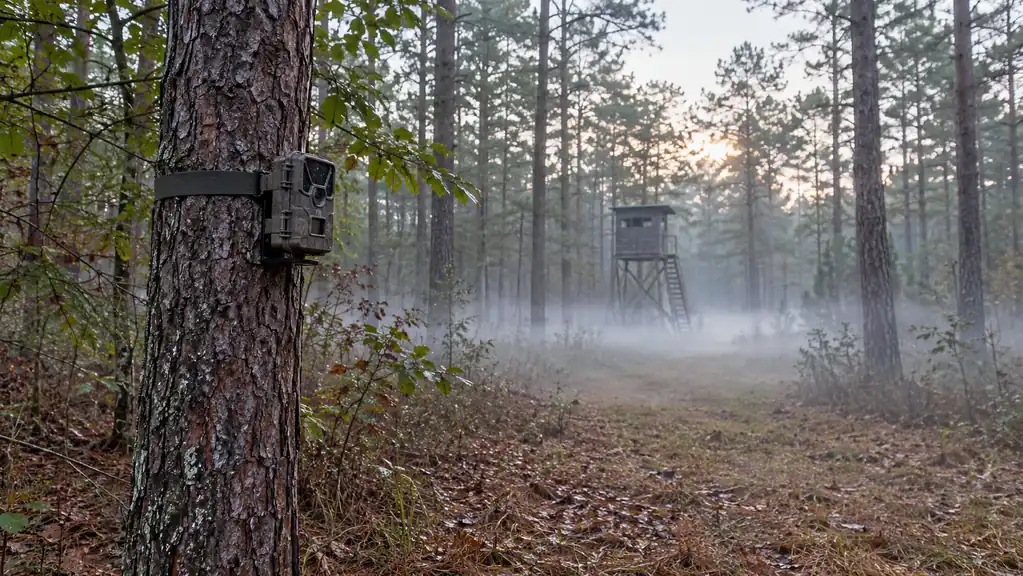
The first trail camera I ever hung on the family lease lasted eleven days. A squirrel chewed the antenna, a coon knocked the whole rig into the creek, and I found it in February with a cracked lens and a card full of nothing but a blurry picture of my own boot. So when I fastened the WOSPORTS trail camera to a pine behind the house the first week of August, I did not have high expectations. I expected to be out there in the dark with a flashlight, cussing, resetting the date and time.
That was five months ago. The camera has run continuous since, through an August that sat at ninety-six degrees with the humidity to match, a wet December that put four inches of water in the creek bottom, and two hard freezes in January that cracked the mud in the road. It has been on three setups: a scrape line along the east fence, a feeder down in the bottom, and the gate where the hogs come through. Some of it worked better than I expected. One thing aggravated me on every single trip out there. Here is the honest version.
The Quick Verdict
A simple, honest, non-cellular camera that takes sharp daylight pictures and usable night pictures. If you want photos texted to your phone, this is not that camera, and WOSPORTS does not pretend it is.
Amazon Check Today's Price →The camera that stayed in the woods when I did not
Five months, three setups, one Louisiana summer and two hard freezes, and it came home working every time. Check today's price before the season turns.
Amazon Check Today's Price on Amazon →How I've Used It
The east fence setup is the one I care about. There is a rub line running north and south along that fence, and every October a buck works it whether I am sitting that evening or not. I hung the camera about fourteen feet up a pine, angled down the line and tilted just off north so the setting sun never hits the lens square. That is the mistake I made for two seasons with an older camera, and I got about four hundred pictures of a sun flare before I figured it out.
I hung it wrong the first time and I will own that. The pine I picked sits about eight feet off the fence line and leans maybe five degrees west. I strapped the camera level to the lean instead of level to the ground, and every picture came back tilted with a third of the frame in the dirt. I moved it up to fourteen feet on a straighter tree the following Saturday, shimmed the back with a scrap of wood lath, and the frame squared up. Two trips and about ninety minutes I did not need to spend, all because I was in a hurry to get it in the woods before dark.
The bottom feeder is the easy setup. Barrel feeder, corn, camera about ten feet off the edge of the throw, and it runs from August on. The gate is the ugly one. It is a gap in the fence where the hogs root through, and it is where I have lost two cameras to mud and one to a curious heifer. The WOSPORTS camera sat through all of it and never took on water.
What I got off those three setups was a real picture of the season. A buck working the scrape at twenty minutes past six in the evening, three nights running, then gone for eleven days, then back. Does and fawns on the feeder from the second week of September. A sounder of hogs at two in the morning, which is the only time those hogs do anything. My granddaughter Kaylee pulled the card with me one Saturday and scrolled through the whole set on the tailgate, and she picked out the same eight-point I had been watching since velvet. That is worth something I cannot put a number on.
Setup and the Two-Inch Screen
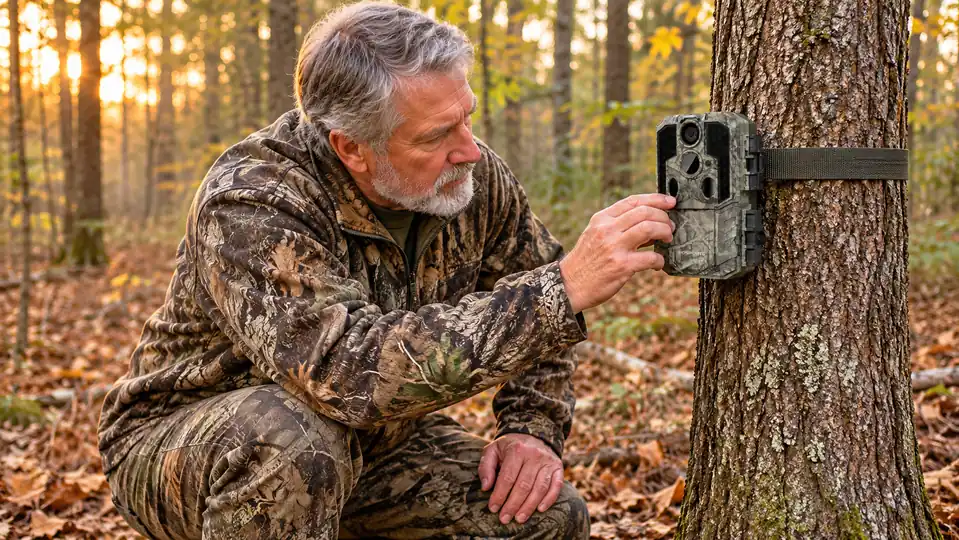
The 2-inch color LCD screen on the front is the feature I did not know I wanted. On every camera I have owned before this one, checking the aim meant pulling the card, walking back to the truck, plugging it into a reader, and discovering the camera was pointed at a sweetgum limb. Then walking back out and doing it again. Here I sit on a bucket, press the buttons, and watch the live view until the shooting lane is where I want it in the frame. It saves me a good twenty minutes and a second trip every time I hang the thing.
Setup otherwise is what you would expect from a camera that runs on batteries and talks to nothing. You put the batteries in, you set the date and time with the push buttons, you choose your picture size, and you walk away. The 64MP setting is adjustable down through 56, 48, 36, 16 and 5 megapixels, and I left mine on a middle setting on purpose. The biggest files are not doing me any good on a card I have to carry back to the house, and a smaller file means room for more deer.
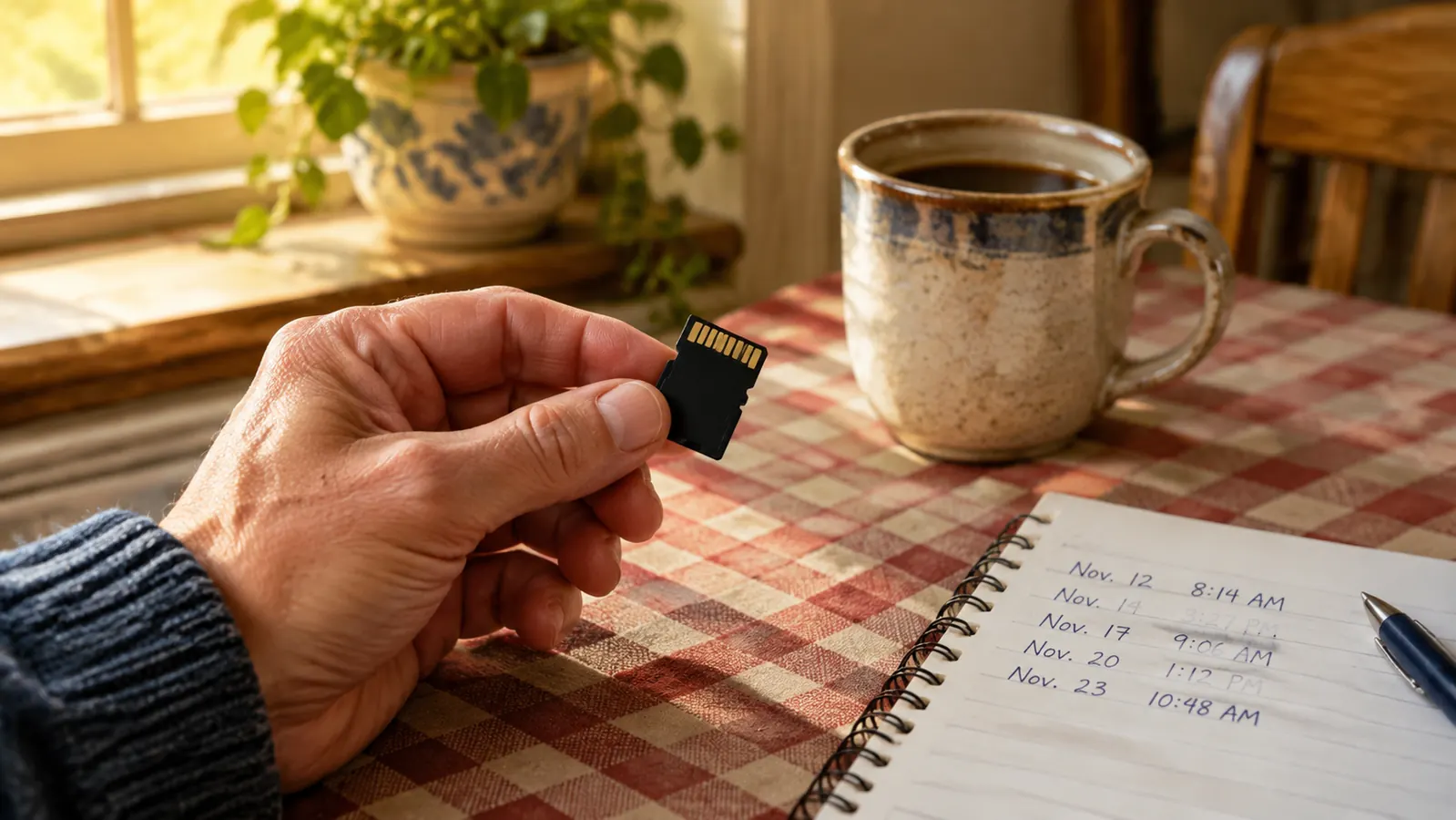
The button layout took me two trips to learn and I am not ashamed to say it. There is a menu button, a set of arrows, and an OK, and the menu tree is shallow enough that a man can walk it in the dark after he has done it twice. What I did wrong was format the card on the kitchen table with my laptop instead of in the camera. The camera did not recognize that card, and the first week produced zero pictures and a good deal of muttering. Once I formatted it in the unit itself, it ran clean. If you take one piece of advice off this page, take that one: format in the camera.
This is a non-cellular, non-WiFi camera, and I want to be plain about what that means, because it is the whole decision. No app. No monthly bill. No checking signal on a lease where the signal is one bar on a good day and nothing at all in the bottom. The trade is that you drive out there and pull the card yourself, which some people will not tolerate and I do not blame them. I am retired and the lease is nineteen minutes from my kitchen, so it suits me fine.
Night Pictures: Where a Camera Earns Its Keep
Most of what I look at happens in the dark, so this is the part that decides whether a camera stays in the truck. The no-glow infrared on the WOSPORTS camera did not spook anything I can prove. I had the same group of does on the feeder at ten at night and again at six the next morning for two straight weeks, and they were not acting like something had flashed them. On a camera with a red glow, I have watched deer go stiff and stare at the tree.
The night I remember is the twelfth of September. I pulled the card at dusk and there were two hundred and six pictures on it, more than that feeder usually throws in a week. A sounder of nine hogs had come in at 1:52 in the morning and stayed about forty minutes. In the near pictures I could see the cut of their ears and which one was favoring a front leg. Out past the throw, where the lane narrows into the trees, they went to grey shapes with bright eyes, and I could not have told a shoat from a coon. That is the honest split. Good inside about twenty-five feet, guesswork past it.
The honest limit is distance. At the feeder, ten feet out, the night pictures are good enough to count points and read an ear tag. At the far edge of the lane the eyeshine is mostly what you get, and a deer walking at a good clip comes out soft. That is not a knock on WOSPORTS specifically. It is what infrared does unless you spend several times as much, and I would rather have a soft picture at fifty feet than no picture at all.
Trigger Speed and the 120-Degree View
The trigger is rated at 0.2 seconds and the detection angle is 120 degrees, and both of those numbers showed up in the field. I set it to a three-picture burst and got the whole sequence on a buck stepping into the lane: nose in, shoulder in, head up and looking at something behind him. On the burst setting of one, half the pictures I would have gotten were the back half of a deer leaving. If you buy this camera, run it on at least two.
I ran a comparison for two weeks in October without meaning to. I had a second WOSPORTS camera in the truck, so I hung both on the same scrape about eight feet apart and set one to a single picture and the other to the three-picture burst. Over eleven days the single-shot unit gave me 62 pictures and the burst unit gave me 214. Of the 62, maybe 40 were deer worth looking at. Of the 214, roughly 170 were deer, because the burst catches the same animal three times and you can see what it did after it stepped in. If all you want is to know that something walked by, set it to one. If you want to know what it was doing, set it to three and buy a bigger card.
The wide view is a trade I made knowingly. A 120-degree lens means the camera watches a piece of ground the size of a two-car garage, which is why I catch deer crossing well off to the side instead of walking straight past. It also means every sweetgum sapling and every tuft of grass in that arc is moving in the wind and setting it off. I cleared a lane about six feet in front of the pine and my picture count dropped by a third with no loss of deer.
Three hundred and forty pictures off one card in eleven days, and the two I actually wanted were a buck at twenty past six in the evening and a hog at two in the morning. It caught both.
Battery, Weather, and the Small Annoyances
The camera is battery powered and waterproof, and it weighs a little over a pound, so it hangs on a pine or a wall post without any rigging. It went through a December that dumped four inches in the bottom and froze the next week, and the housing was dry every time I opened it. That is more than I can say for a camera I paid more for in 2019 and buried in the barn.
The freeze is what I will remember. The second week of January we had two nights at eighteen degrees and the ground down in the bottom cracked open. I walked out expecting to find the housing split at the seam, because I have had that happen to another camera. It was fine. What I did not expect was how much cold changes the battery math. The picture count fell off in a way that had nothing to do with deer movement, and it took me a week to figure out that was the batteries and not the deer. I now swap them before the first hard freeze instead of after. That costs me one set and saves me a week of guessing.
The annoyances are real, so I will list them. The 2-inch screen is a blessing on a bucket and a nuisance in direct sun, and on a bright afternoon I have to cup my hand over it and squint. The wide lens means housekeeping, because if you do not clear the grass you will sort through a lot of nothing. And a three-picture burst on a windy site will fill a card faster than you expect, which is why I now carry a spare in the truck. None of that is a defect. It is just the cost of the features I wanted.
What I Liked
- Sharp daylight pictures at the 64MP setting, and the file size is adjustable down to 5MP when you want more pictures per card
- 2-inch color LCD lets you aim the camera on the spot instead of walking a card back to the truck
- No-glow infrared night pictures that did not seem to bother deer on a baited feeder
- 120-degree detection angle catches deer crossing wide of the lane, and the 3-picture burst catches a whole sequence
- Waterproof housing that came through a wet Louisiana December and two hard freezes dry inside
- No app, no signal, no monthly bill, which is the whole reason I bought it
Where It Falls Short
- Non-cellular and non-WiFi, so you have to walk out and pull the card yourself, every time
- The 2-inch screen is hard to read in direct afternoon sun
- Wide lens picks up every moving limb and patch of grass unless you clear the ground in front of it
- Night pictures go soft past the near edge of the lane, which is normal for infrared at this end of the market
- Three-picture bursts fill a card quickly on a windy setup
Who This Is For
This camera is for the hunter who wants to know what is on the property and does not want a data plan to find out. If you run two or three cameras on a lease and you are out there most weekends anyway, the WOSPORTS camera does the job it is supposed to do. It is also a sensible first camera for a kid or a grandkid, because the screen on the front means they can see the picture without you hauling a laptop onto the tailgate. Kaylee figured out the buttons in about four minutes, and she is eleven.
Who Should Skip It
Skip it if you want a picture on your phone while you are sitting in a stand in another parish, because this camera cannot do that and no setting will make it. Skip it if your property is four hours away and you only get out twice a season, because a camera you cannot check is a camera that is just sitting there. And skip it if you are the type to leave the grass growing in front of the lens, then complain about the picture count. Buy a cellular camera, pay the bill, and be honest with yourself about why.
One season in the woods is the only review that counts
Five months of Louisiana heat, water and freezes, three setups, and it never came home broken. If that is the kind of camera you are after, look at today's price and read the recent reviews yourself.
Amazon Check Today's Price on Amazon →