
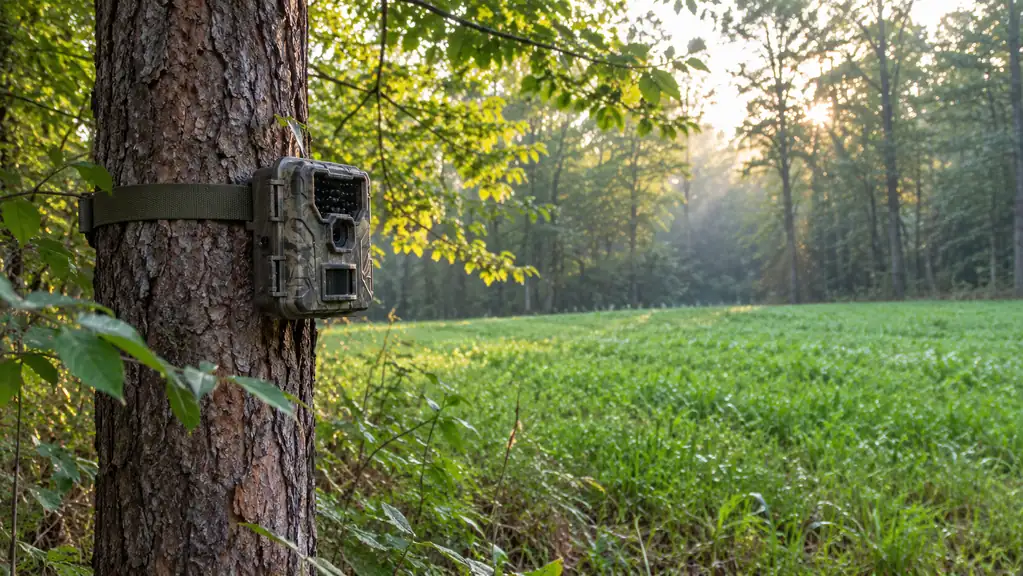
I run two cameras on the same north Louisiana lease, and they are not doing the same job. The WOSPORTS trail camera is a battery-powered, non-cellular, non-WiFi box that hangs on a tree and keeps its pictures to itself until I walk out and take the SD card out of it. The Moultrie cellular camera sends those pictures to my phone over the cell network and charges me for the privilege every month.
Both of them took deer pictures. Only one of them earned its keep on my place. If you are standing in a store aisle trying to decide which kind of camera you actually need, here is the short version: if the camera is going somewhere you drive past once a week, the WOSPORTS is the better buy. If it is two miles back in a swamp you only see in November, cellular starts to make sense, and you had better be ready to pay for it all year.
| WOSPORTS Trail Camera | Moultrie cellular camera | |
|---|---|---|
| Ongoing cost | Nothing after the batteries. Buy the card once and reuse it for years | A monthly data plan per camera, billed whether deer move or not |
| How you get the pictures | You walk out, open the latch, pull the card, carry it home | They land on your phone within a minute or two, from the couch |
| Signal needed | None. It works in a hollow where your phone shows zero bars | Needs usable cell coverage at the camera or it silently quits sending |
| Battery life | Battery Powered, 8 volts, and it sits dormant between triggers | Cellular radios are always awake and hungry, so it eats batteries faster |
| Photo quality | 64MP stills, adjustable down to 5MP, plus 4K video | Depends on the model and the plan tier, usually tuned for fast transmission |
| Night range | No-glow infrared, so nothing blinks at the deer | Infrared, but the low-glow models will show a faint red blink |
| Setup effort | Four steps: batteries, card, strap, walk away | Batteries, card, strap, then an app, an account, and a signal check |
| Best for | A lease you can drive, a yard, a barn, a feeder behind the house | A far-off property, a public-land spot, a place you visit twice a season |
| Theft risk | You lose a camera and a card, that is the whole loss | You lose the camera plus a data plan you are still paying on |
I want to be fair to the cellular camera, because it does one thing the WOSPORTS simply cannot do, and for a certain kind of hunter that one thing is worth every dollar. I will get to that. But it took me about a month to stop resenting the monthly bill, and I never once resented pulling a card.
Where the WOSPORTS Wins
The first win is the one nobody talks about at the counter: it costs nothing to keep running. I put batteries in it in late August and I have never once thought about a subscription, a data cap, or whether the camera was still on the network. When you are running four or five cameras across a lease, that difference stops being a rounding error and starts being a truck payment.
The second win is that it works where there is no signal, and a lot of good deer hunting happens where there is no signal. The bottom behind my ladder stand is a hole. My phone drops calls there. A cellular camera in that bottom is a plastic box that takes pictures nobody will ever see, and you will not find out until you go check it in December and realize you have been paying a monthly fee for a camera that has been offline since September.
Third, the picture quality is honestly more than I need. The listing says 64MP, adjustable down through 5, 16, 36, 48 and 56MP, and it will shoot 4K video. I run mine at a middling setting because a 64MP file on a 32-gig card fills up faster than you think when a doe and two fawns stand in front of it for twenty minutes. The 120 degree wide angle catches more of the plot edge than I expected, and the 1 to 3 burst mode means a buck walking through usually gives me two or three frames to pick from instead of one blurry one.
The trigger speed is the spec I did not care about until I did. The listing says 0.2 seconds, and what that means in the real world is that a buck crossing the plot edge at a steady walk still lands in the frame instead of halfway out of it. My first camera years ago had a trigger you could time with a sundial, and I have a shoebox of pictures of empty green grass and the south end of a northbound doe to prove it. I mounted the WOSPORTS chest high on a pine about twelve feet off the plot edge, strapped tight, angled down maybe ten degrees. The whole unit weighs right at a pound and a quarter, so a strap holds it dead still with no wobble, and the tree mount is all you need. No stake, no tripod, no bracket to buy.
Fourth, night pictures. No-glow infrared means no red blink, and on my place that matters, because I have had does look straight at a low-glow camera and leave. The 2-inch color LCD on the back is the other quiet feature I use more than I thought I would. I can pop the card and check the last few frames right there at the tree instead of driving home, loading a card, and driving back out because the camera was pointed at a branch.
The camera that costs you nothing after you buy it
Battery powered, no plan, no signal, no monthly bill. 64MP stills, 4K video, no-glow infrared, and a 2-inch screen so you can check the shot without hauling the card home. If your camera site is a place you can drive to, this is the one that keeps working.
Amazon Check Today's Price on Amazon →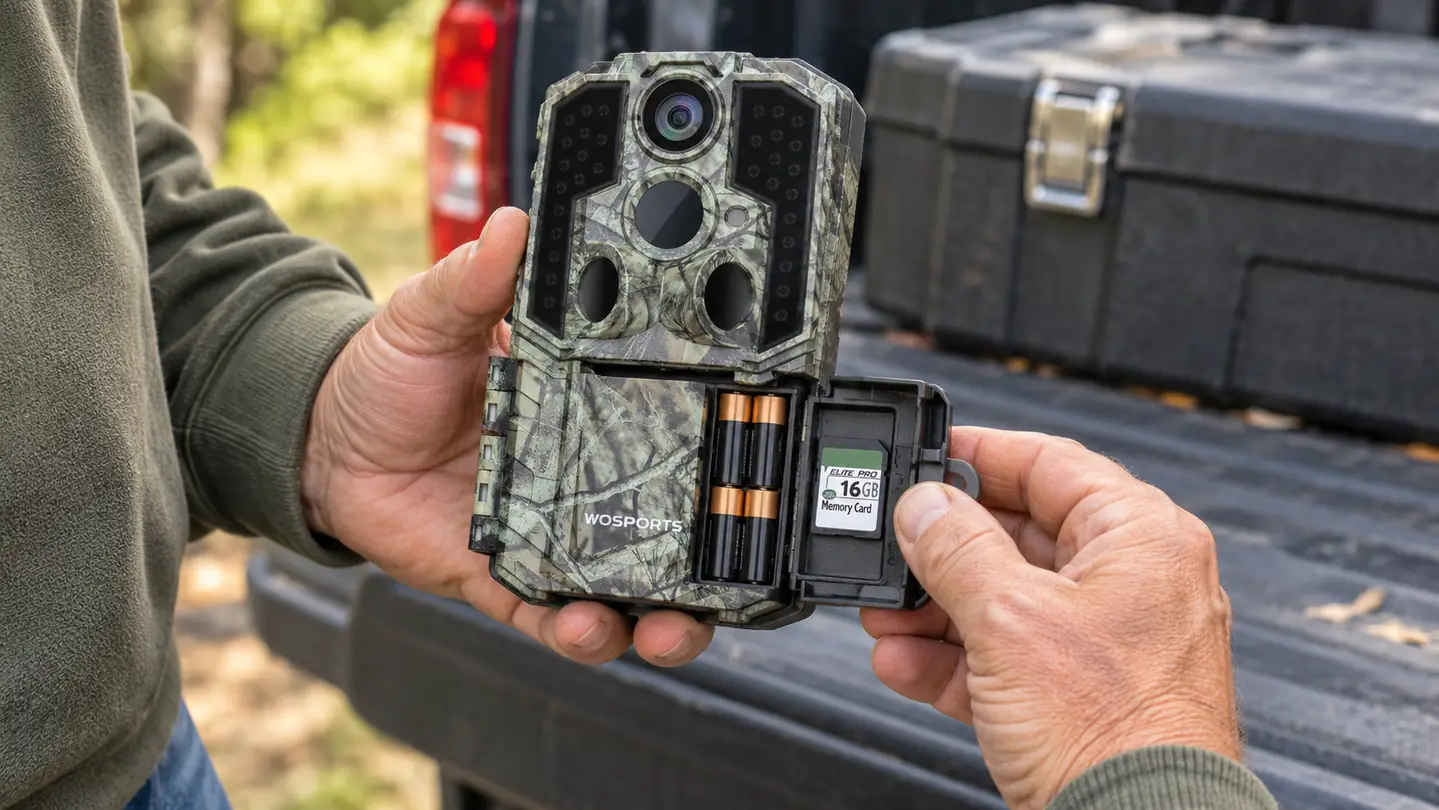
Where the Moultrie cellular camera Wins
Here is where I eat my words. When the cellular camera works, it is genuinely better than walking. I sat in my kitchen in October with a cup of coffee and watched a nine-point buck work a scrape at 7:40 in the morning, a half hour from the house. I knew he was there before I had put my boots on. That is real, and no amount of card-pulling replaces it.
The second place it wins is pressure. Every trip to check a camera is a trip that leaves scent and noise on your ground. If you are hunting a mature buck on a small lease, or worse, a piece of public land where everybody else is walking too, running a cellular camera on the far side and never setting foot near it is a genuine tactical advantage. I have bumped deer walking in to pull a card. I have never bumped one from my kitchen.
It also wins on the thing a lot of hunters will not admit: it is convenient enough that you actually look at the pictures. I have pulled cards off the WOSPORTS and let them sit in the truck console for two weeks. The phone buzzes and I look. That difference in attention is worth something when you are trying to pattern a deer before the season opens.
I sat in my kitchen in October and watched a nine-point buck work a scrape at 7:40 in the morning, a half hour from where I was sitting.
What it does not win is reliability. Cell coverage on a lease is not a promise, it is a hope. I have had weeks where the camera sent nothing and I assumed the deer had moved, and then pulled the card and found forty pictures it never managed to push. That is the part that stings: you did not just lose the pictures, you lost the season's worth of confidence that the pictures mean anything.
Case in point. The second week of October a front pushed through and I got eleven pictures in six days off that far scrape. I figured the deer had shifted to the acorns up on the ridge, and I very nearly moved a ladder stand over it. Then I walked in on the 19th, pulled the card, and it held sixty-one pictures from those same six days that never made it out of the camera. Whatever that unit thought it was doing, it was not talking to the tower. Had I been hunting off the phone alone, I would have moved a good stand for no reason at all and never known why.
What I Would Tell You Before You Buy Either
Decide based on your drive, not your wants. Sit down and count how many times a month you will realistically put hands on that camera. If the answer is four or more, the WOSPORTS wins on cost and simplicity and you should stop reading reviews and go buy it. If the answer is one or two, or if the camera is going somewhere you cannot easily reach, cellular is the only thing that makes sense.
Set both of them up the same way. Fresh batteries, name-brand, not the ones from the bargain bin. A card that is actually rated for the camera, formatted in the camera, not on your laptop. Mount it chest high on a tree that gets a little shade if you can, angled slightly down so the sun does not come straight into the lens at first light. I have wasted more pictures on a bad angle than on a bad camera.
The other thing I would tell you is to count the batteries out loud before you close the latch. I made that mistake exactly once, on a December afternoon with the light already going, and I put three fresh ones and one half-dead one into a camera and did not find out until January. A camera will not tell you it is running low. It just quietly stops, and you spend three weeks believing the deer left the country. Same story with the card. Format it in the camera, not on the laptop, because a card that has been living in your desktop computer can act like a card that was never formatted at all.
Leave it alone longer than feels right. The first week is mostly you and your own scent. The second week the deer start coming back. I used to check every five days and wonder why I only got pictures of raccoons. Now I check every two weeks and get the deer.
Who Should Buy Which
Buy the WOSPORTS if you hunt a lease you can drive to, if you keep a camera on a feeder behind the house, if you want to watch a barn or a gate or a driveway, or if you are running several cameras and cannot stomach several monthly bills. It is also the right first camera for somebody who has never run one, because the setup is four steps and there is nothing to troubleshoot. It is a battery-powered box with a motion sensor, infrared light, and a screen, and it does exactly that.
Buy the Moultrie cellular camera if your ground is far, your time is short, or your deer are pressured and you cannot afford to keep walking in. Budget for the plan the way you budget for corn, and check the signal at the camera site with your own phone before you buy, not after. If your phone shows one bar standing at that tree, do not buy a cellular camera for that tree.
Earns its keep at every site you can reach
No plan, no signal, no monthly bill. Runs on batteries, holds its pictures until you come get them, and holds up season after season on the same card. If you can drive to the tree, this is the camera that pays you back.
Amazon See the WOSPORTS Trail Camera on Amazon →What I Actually Kept in the Truck
I still run the cellular camera on the far end of the lease, and I will keep running it, because that scrape is a quarter mile from the nearest road and I am not walking in there every week in October. But the WOSPORTS is the camera that lives in the toolbox, the one that goes on the feeder behind the house, the one I hand to my granddaughter when she wants to see what is coming to the back pasture. It has been rained on, dropped off a tailgate, and left out through two Augusts, and it is still taking pictures.
Three seasons on that same pine, and the tally is not exciting, which is the whole point. Two Augusts of ninety-five degree heat with the humidity sitting on you like a wet blanket. One October where we took eleven inches of rain in a week and the plot flooded clean up to the strap. A drop off the tailgate onto gravel that I figured had finished it for good, and it took pictures the next morning anyway. It is rated waterproof and I have tested that rating whether the maker intended me to or not. I have not had to think about that camera since the day I hung it, and after a while that is the highest thing you can say about a piece of gear.
That is the whole test, really. Not which camera is more advanced. Which one is still doing its job in year three without me thinking about it. One of them is. The other one is doing its job and sending me an invoice to remind me.