
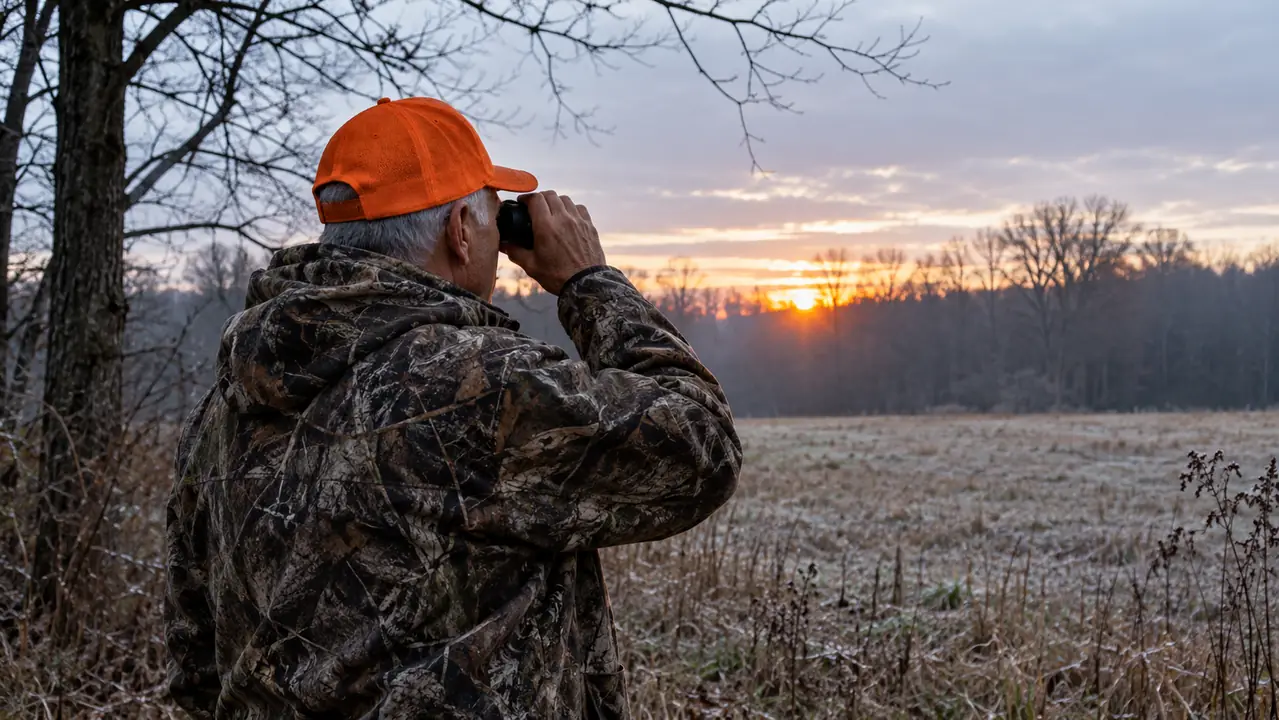
The first time I used the TIDEWE rangefinder I was forty minutes into a ladder stand in Vernon Parish with the temperature sitting at twenty-nine degrees, and I ranged the same white oak three times before I believed the number.
That is not a knock on the unit. It is what a man does the first time he trusts a new tool. I had carried a borrowed rangefinder for years, an old fixed-magnification model with a coin battery I could never find at the hardware store, and when it finally died on me last fall I decided I was done with borrowed gear. I ordered the TIDEWE Hunting Rangefinder, the rechargeable camo model, mostly because it did not use a coin cell and because it cost less than what I had budgeted. Six months later I have ranged deer, hogs, a treeline of cypress, my own truck, and Boudreaux on the far side of a duck blind, and I have opinions.
The Quick Verdict
A genuinely useful hunting rangefinder for the money. Fast, accurate to within a yard in my testing, and it survived a Louisiana winter in a pack. The display washes out in bright direct sun and the case is thin. Neither one stopped me from using it.
Amazon Check Today's Price →The rangefinder that lived in my pack for a whole season
Six months of ladder stands, duck blinds, and cold mornings. It still reads true. Check the current price and see the full listing before you commit.
Amazon Check Today's Price on Amazon →How I've Used It
I want to be specific about the conditions, because a rangefinder that works on a mild October afternoon and a rangefinder that works on a thirty-degree January morning are two different tools.
This one rode in the top pouch of my pack from late October through the end of duck season. It went up a ladder stand on our family lease a dozen times. It sat in a blind on public land three mornings, one of which was foggy enough that I could not see the decoys clearly at twenty-five yards, and I still ranged the far edge of the spread at forty-one. It rode on the console of my truck for scouting trips and got rained on once, briefly, when I left the window down. It has been dropped off the edge of a shooting rail onto a fiberglass floor and it still powers on and reads.
I keep a little routine now. Before daylight I range the three or four landmarks I might need that morning: the big white oak on the left, the gap in the fence line, the far edge of the food plot. I write those numbers on a strip of masking tape stuck to the shooting rail, because at six-fifteen with cold hands my memory is not what it was at forty. By the time a deer shows up I am not doing arithmetic in my head, I am looking at a number I already wrote down. That habit is worth more than the rangefinder itself, and I only started it because the TIDEWE made ranging fast enough to be worth doing in the dark.
What I used it for, mostly, was the boring work that makes the shot. Checking whether a deer at the property line was inside the boundary or not. Checking a gap in the timber to know if it was thirty-five yards or fifty, because those are two different pins and I need to have decided which one before the animal steps in. And on the duck side, ranging a specific bare spot in the outer spread so I would know when to stop calling and start shooting. None of that is glamorous. All of it is the reason a rangefinder is worth carrying at all.
The Numbers That Actually Mattered
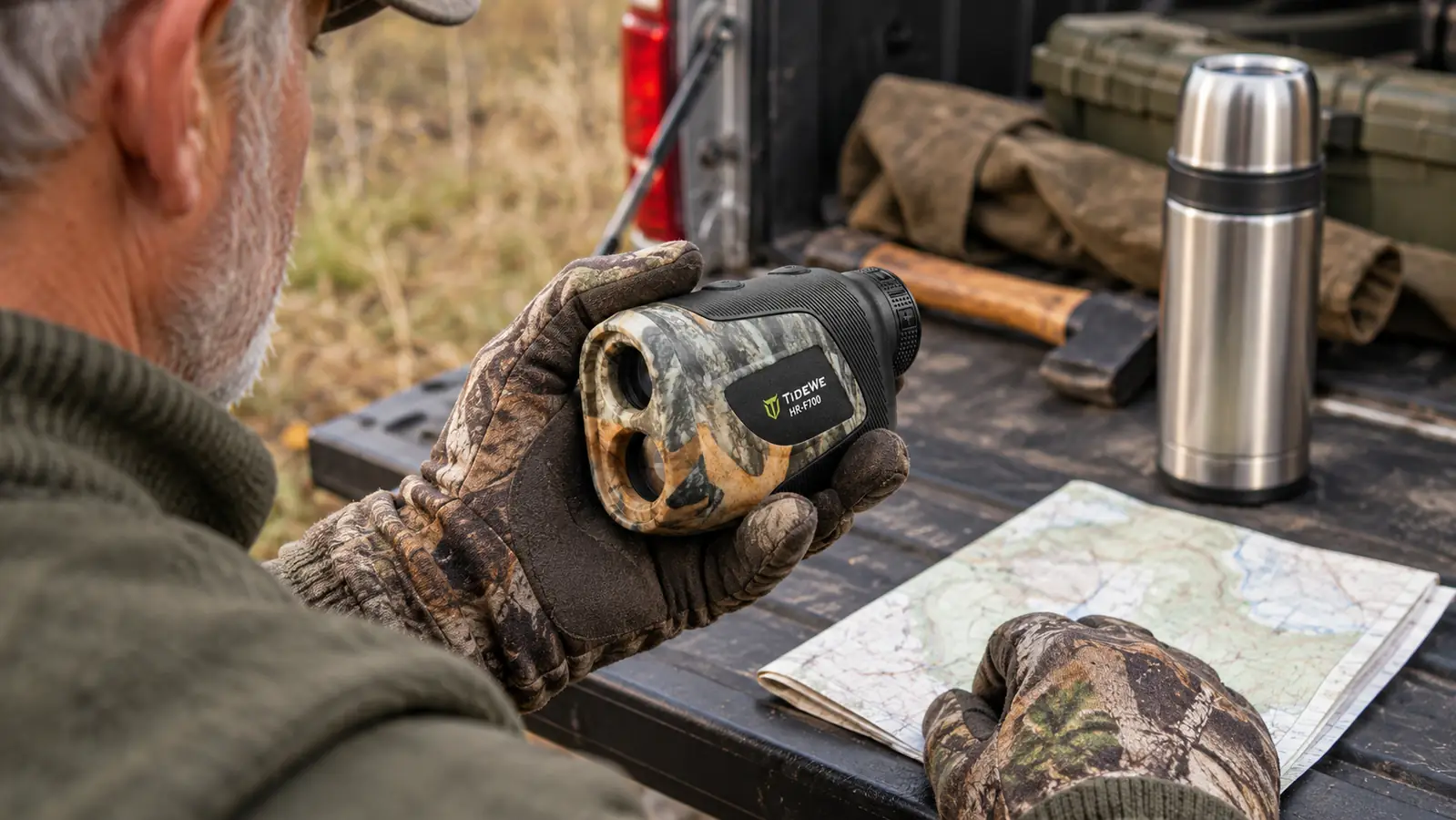
The TIDEWE is rated from 3 to 700 yards with plus or minus one yard of accuracy, and it carries 6x magnification, which the listing describes at 6.5x in the feature bullet and 6x in the attribute field. I cannot resolve that discrepancy for you and I am not going to pretend I measured it, because I did not.
What I can tell you is what happened in the field. The farthest I ever got a clean reading was 412 yards on a big cypress at the back of a flooded flat, and it took maybe a second and a half of holding still. On deer-sized targets inside two hundred yards, which is the range that matters to me, it reads almost instantly. I had no trouble ranging a doe at 87 yards in flat gray light, and no trouble ranging a hog at 143 through a hole in the brush. Accuracy against known distances was consistent, which is the thing that matters. I have a range at the lease with stakes set at 100, 200, and 300, and the unit read within a yard of each every time I checked it, warm or cold.
I did that stake check twice, and I want to be clear that both times were miserable. Once in August with the temperature at ninety-four and sweat running into my eyes, once in January with the unit having sat in a cold truck overnight. Same result both times. What I did notice is that it wants a steady hand more than it wants good light. If I was breathing hard from walking up the hill to the range, the reading took a beat longer, which is fair and true of every rangefinder I have ever picked up. Bracing my elbow on the stand rail fixed it every time, and that is a habit worth having anyway.
It also gives straight-line distance, vertical distance, horizontal distance, and speed. I used the angle-compensated horizontal reading exactly once, on a downhill shot in some rolling ground where I had climbed higher than I thought. That is the one place a hunting rangefinder earns back its whole price, because shooting high on a steep angle is a miss waiting to happen. Most of the time I never leave the straight-line mode and I am glad of it. The fewer things to fiddle with in the dark, the better.
It read within a yard of my 100, 200, and 300 yard stakes every single time I checked it, warm or cold or cold and wet.
What Held Up and What Gave Me Trouble
The rechargeable battery is why I bought it and it is why I would buy it again. I charged it once before the season and once around Christmas, and that was it. The listing calls it lithium-ion, and it charges off the same cord I use for my phone, which means one less special battery to hunt for in a drawer at five in the morning. If you have ever dug through a kitchen junk drawer at four-thirty looking for a CR2, you understand why this alone is worth something.
As for the battery, here is what convinced me. I charged it the night before the season opened, used it hard for two weeks, and then left it in the pack through a month of the wettest weather we had. Christmas week I pulled it out expecting to find it dead and it came on with charge to spare. I have had headlamps that would not do that, and I have thrown more than one of them away over it. The other thing I will say is that a rechargeable unit only helps if you remember to charge it, so I made a habit of plugging it in the same night I plug in my phone.
The size of the TIDEWE is right for a jacket pocket. It measures about 4.12 by 2.61 by 1.5 inches and weighs 5.67 ounces, which is light enough that I forgot it was in the pouch. Water resistance is listed as IP54 and waterproof, and while I did not submerge it and would not, it came through a wet morning without fogging internally, which is the failure I worry about most with optics in Louisiana humidity.
Now the honest part. The display is not wonderful in bright direct sun. On a clear high-noon October day with the sun coming over my shoulder, I had to cup my hand around the eyepiece to read the numbers clearly, and on one occasion I gave up and just did not range that particular deer. The reticle is fine and the numbers are legible, it is the washout that bothers. I also found the included case to be thin and not particularly protective, more of a sock than a case, so I swapped it for an old pouch I had, and I would plan on doing the same.
The rubber eyecup is comfortable enough with bare eyes and it does not slam my brow, which is more than I can say for the old borrowed unit. The focus ring takes a little getting used to. It is not stiff, it is just that the ring is small and gloved fingers do not love it, so I set the focus bare-handed at the start and left it alone.
What I Liked
- Rechargeable lithium-ion battery, no coin cell to hunt for
- Reads fast and consistently inside 200 yards, which is the range most deer get shot at
- Verified within a yard of my 100, 200, and 300 yard stakes
- Angle-compensated horizontal distance saved me on a downhill shot
- Light enough at 5.67 ounces to forget it is in the pack pouch
- Came through wet Louisiana mornings without internal fogging
Where It Falls Short
- Display washes out in bright direct sunlight
- Included case is thin, more of a sock than a case
- Focus ring is small and awkward with gloves on
- Small discrepancy in the listing between 6x and 6.5x magnification, and no clear answer in the box
Two Sides of a Louisiana Season
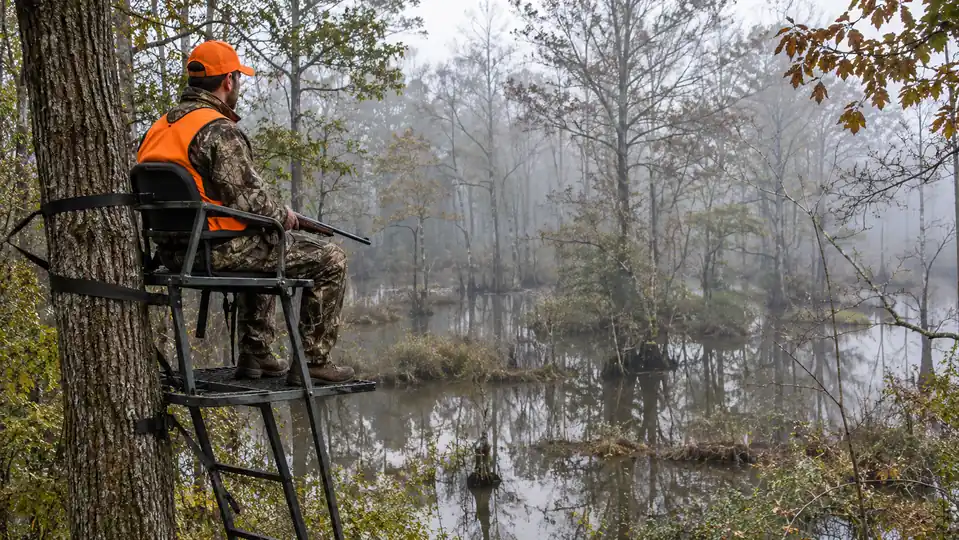
Deer season is where this thing lives for me, and the reason is simple: our lease has a fence line down the east side, and there is a hardwood draw about sixty yards inside it that deer like to travel. In the past I have passed on animals I should have taken and taken animals I should have let walk, entirely because I was guessing at the distance and guessing wrong. Being able to check a gap once and know it is forty-two yards changes how you sit in a stand. You stop negotiating with yourself.
The morning that settled it for me was the second week of November. An eight-point came down the draw and stopped behind a sweetgum at what I would have called fifty yards if you had asked me from the stand. I ranged him at forty-two. Forty-two is inside the pin I had set and fifty is not, and that gap is the gap between a clean animal and a long tracking job after dark. I killed that deer. I am not going to tell you the rangefinder killed it for me, because it did not, and I am not going to tell you I would have missed without it, because I might not have. What I will tell you is that it took one guess out of a morning that already had plenty of them in it.
Duck season was the other half of the test, and it was a harder test, because water and cold and fog are what kill electronics. In a public-land blind on a thirty-degree morning with the fog thick enough to blur the outer decoys, I ranged the far edge of my spread at forty-one yards and the near edge at nineteen, and both numbers matched what I had walked off the day before. Boudreaux sat in the blind and shivered and did not care about any of it, but I cared, because knowing the outer edge is where cripples get missed and I would rather have the number than the guess.
The one time it let me down was the sun, already mentioned. The one time I let it down was leaving it on the truck console in the rain with the window cracked. It came through both. That is about as fair a season as a piece of equipment can get.
Who This Is For
If you are a deer hunter who sits in a ladder stand or a ground blind and you have been guessing at yardage, this is the tool for that job and it does the job. It is also a good fit for the hunter who is tired of special batteries, because the rechargeable side of it is genuinely convenient and the charge held through months of intermittent use. And if you are on a budget and want a hunting rangefinder that reads true inside two hundred yards without paying premium optic money, this is where I would start.
It is also a reasonable choice for a first rangefinder for a younger hunter. My granddaughter Kaylee is eleven and fishes with me on weekends, and when she is old enough to sit a stand I would hand her this one without worrying about it, because it is light, it is simple, and there are only a couple of buttons to learn.
Who Should Skip It
If you are a western hunter routinely taking shots past four hundred yards, or a long-range shooter who needs to range steel at eight hundred, this is not your tool. The reach is listed to 700, and I got a clean reading at 412, but this is a hunting instrument built for the ranges hunters actually shoot, and I would not ask it to be a precision instrument for extreme distance. Buy once and buy properly for that job.
Skip it too if bright sun and a clear display are non-negotiable for you, because the washout in high sun is real and it is the main thing I would change. And if you want a rangefinder that comes with a substantial hard case, budget for a better one on the side, because the included case will not protect much.
If you want to see how it stacks against the brand most people compare it to, I put that side by side in my TIDEWE versus Vortex comparison, and if you are still deciding whether you need one at all, my piece on how a rangefinder saves your shot covers the cases where the answer is yes and the cases where it is not. Either way, the thing I would tell you is the same: a rangefinder does not make you a better shot. It stops you from making a bad guess, and in my experience those are two different problems.
It earned the pouch in my pack for another season
Fast readings inside 200 yards, a battery that held a charge for months, and it came through wet Louisiana mornings. If that is the job you need done, go look at the current price.
Amazon Check Today's Price on Amazon →